











Seasons
Spring in the High Desert
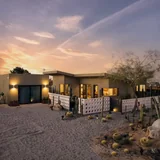
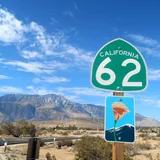
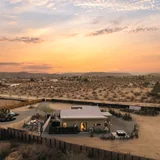
Spring is the mild stretch in the high desert. The daytime heat that keeps Joshua Tree quiet all summer hasn't arrived yet, the light runs long into the evening, and in the right years the desert floor fills with colour. If you have been waiting for the season when a hike, a swim and a night under the stars all fit into one day, this is it. Stargaze Escape sits in Yucca Valley, about a 25-minute drive from the park's west entrance, which makes it an easy base for exactly that kind of trip.
Why Spring Is the Easy Season
Joshua Tree runs on temperature. In summer the daytime highs regularly pass 100F and the trails empty out by mid-morning; in the depth of winter the days stay cool and the nights drop to freezing. Spring lands in the comfortable middle. From roughly March into May the days sit in a range most people find easy to be outside in, the desert wakes up, and the light stretches later every week.
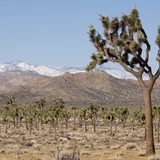
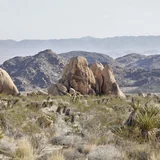
Part of the reason it feels so temperate up here is elevation. Yucca Valley sits at about 3,300 feet, high enough that it runs cooler than the low desert around Palm Springs, roughly a 50-minute drive down the hill. That extra elevation takes the edge off. The park itself covers a transition zone between two deserts — the higher, cooler Mojave in the west and north, where the Joshua trees grow, and the lower, hotter Colorado Desert in the south and east, home to ocotillo and dense cholla. Spring is the one season when both halves are pleasant to explore on the same trip.
The wildlife follows the same comfortable window. Reptiles are cold-blooded, so they are most active in spring and fall and shelter from the summer heat and winter cold. Desert tortoises spend about 95% of their lives underground in burrows that can run up to 30 feet long, and they come up mainly in spring to feed and find mates; they are a threatened species, so if you are lucky enough to see one, keep well back and never handle it. Coyotes, black-tailed jackrabbits and desert cottontails are most active around dawn and dusk. Among the birds — more than 250 species have been recorded here — the cactus wren nests in the cholla, Gambel's quail move in coveys, and the greater roadrunner turns up on the ground, hunting lizards and insects rather than taking to the air. Much of this wildlife lives in the open desert around Yucca Valley, not only deep inside the park.
The one catch is that everyone else has the same idea. Spring is the park's busiest, most crowded stretch, so the easy weather comes with company. A little planning around when you enter the park and which trailheads you choose goes a long way, and it helps to read up on how the seasons compare before you lock in dates.
The Weather in Spring
Spring and fall are the mildest, most pleasant months in the high desert. Typical spring days run somewhere around 65 to 80F. That is an average, though, and any given day can land well outside it — this is the desert, and individual days routinely run hotter or colder, so check the forecast for your actual dates rather than trusting a seasonal range.
The shape of the season matters as much as the average. Early spring, in March, still carries winter's cold nights; temperatures can dip toward freezing after dark, especially in the first few weeks. By late May the days are climbing into the 90s and summer is close behind. April tends to be the sweet spot — warm in the afternoon, cool at night. Across the whole year Yucca Valley temperatures usually range from about 34 to 95F, rarely colder than the mid-20s or hotter than about 101F.
Rain is scarce and mostly a winter matter. The summer monsoon storms that can trigger flash flooding and a second desert bloom don't usually arrive until July or later, so spring is generally dry. Snow is rare up here — an occasional light dusting can happen, but it doesn't tend to stick. Spring afternoons can turn breezy in the open desert, so a windbreaker is a sensible layer to have along. What all this means for packing: dress in layers. A morning that starts near freezing can become a warm afternoon by the pool, and the swing between midday and midnight in the desert is large in any season.
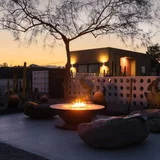
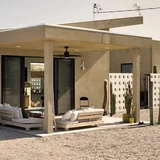
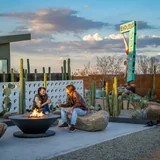
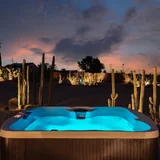
The house is built for that swing. There is air conditioning and heating inside, the private hot tub is open all year, and the stock-tank pool warms up as spring goes on. On a cool early-spring evening the hot tub and the gas fire pit do the work; by May the pool is the main event.
Wildflowers and Why They Vary
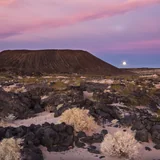
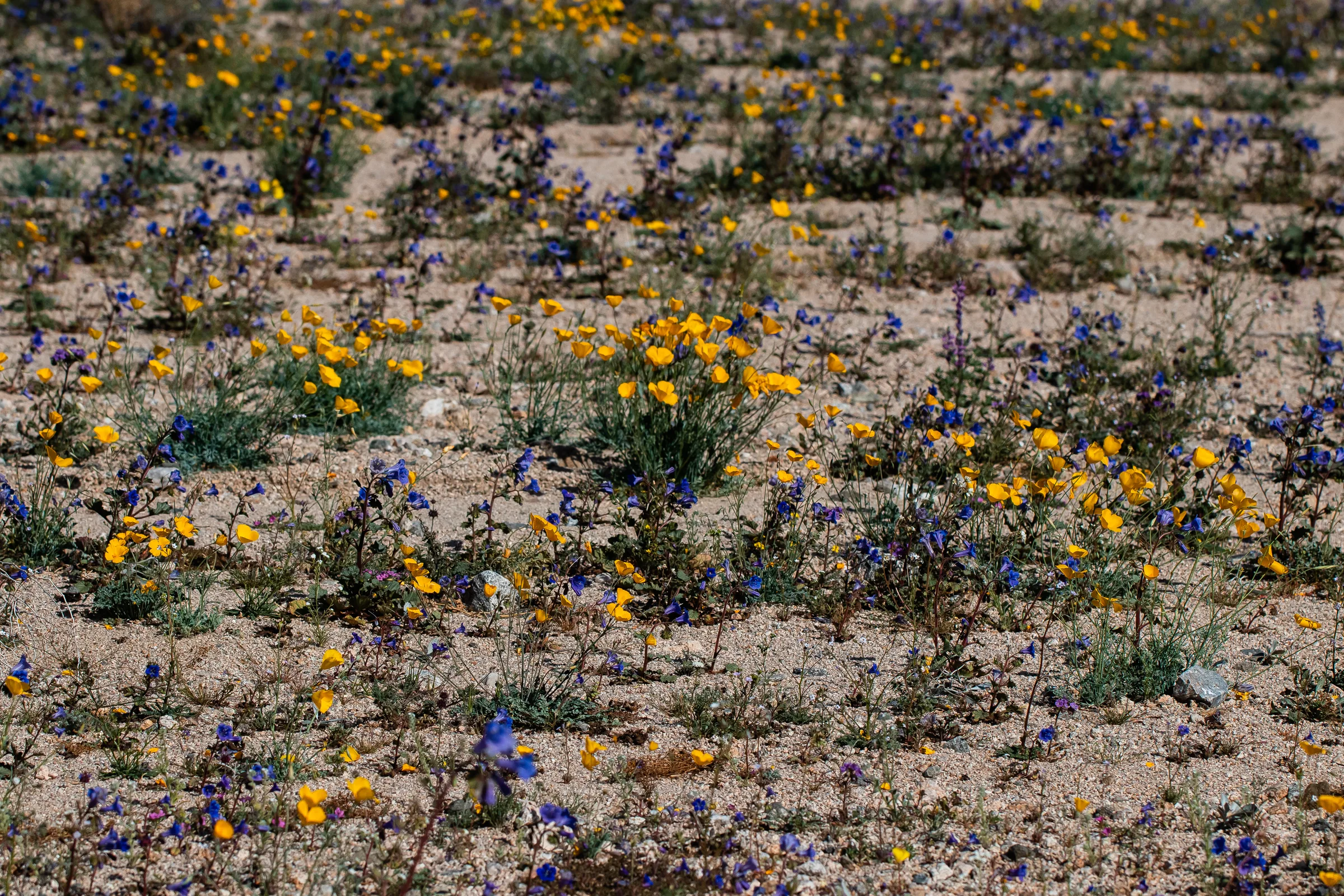
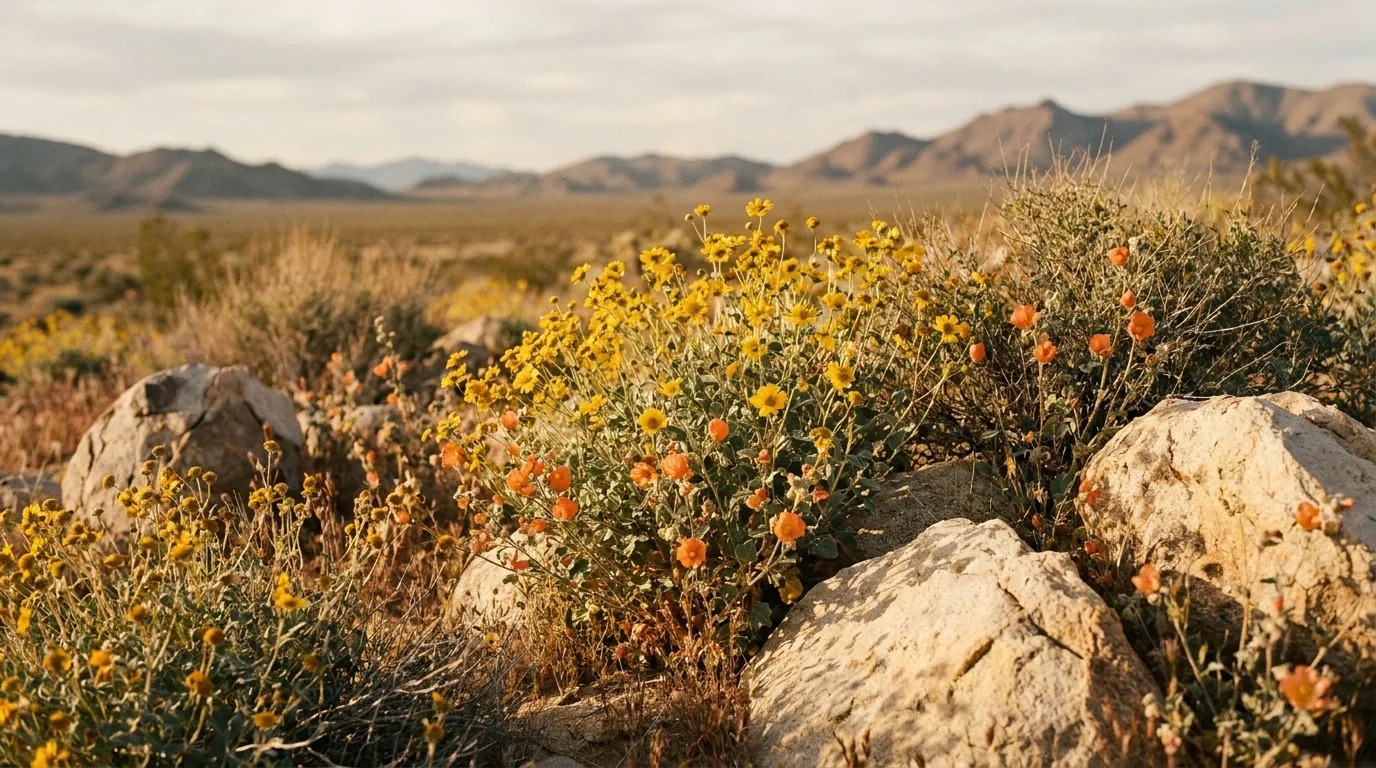
Wildflowers are the reason a lot of people come in spring, and they are also the least predictable thing about the season. In general the desert blooms somewhere between February and June, working its way up by elevation: the lower elevations flower earliest, from January into mid-April; the middle elevations around 3,000 to 5,000 feet follow, early March into early May; and the highest ground above 5,000 feet comes last, April into June. Peak viewing across the park is usually March and April. Treat all of those windows as rough — bloom timing shifts every year, so the park's current wildflower report is the only reliable guide for a specific week.
Why so variable? It comes down to winter rain. For a strong bloom the seeds need about half an inch of rain in a single event, followed by evenly spaced storms through the season. Miss that rhythm and the display is thin no matter how warm the spring turns. The spectacular "super bloom" years that make the news happen only about every five to ten years — 2019, for instance, followed a winter with 229% of average precipitation. Most springs are quieter than that, and some are nearly bare. Go in with the wildflowers as a bonus rather than the whole plan, and you won't be let down.
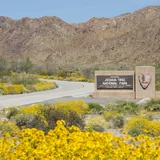
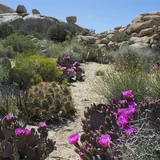
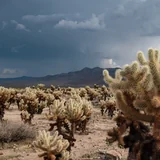
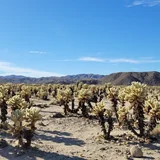
When conditions do line up, the colour comes from a mix of plants. Brittlebush throws up masses of yellow, daisy-like flowers on long stalks. Ocotillo — a tall, spiny plant that is not a cactus — sends up red-orange tubular flowers, mostly in the southern, lower part of the park around the Pinto Basin and Cottonwood, and mostly from March into May. The teddy bear cholla that forms the famous garden in the Pinto Basin blooms in that same March-to-May window. Barrel cactus, on the rocky slopes, tends to flower later, yellow to reddish in late spring. Desert willow, along the washes, opens pink-purple trumpet flowers.
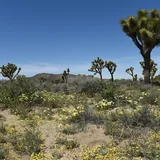
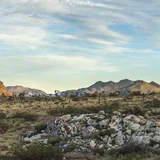
Because the park spans two deserts, the show is different depending on where you drive. The higher Mojave country in the north and west is Joshua tree and yucca terrain; the lower, hotter Colorado Desert in the south, around the Pinto Basin and Cottonwood, is where the ocotillo and cholla concentrate. In a good spring it is worth the drive to the south end to see the ocotillo in flower, since it grows only sparsely up around Yucca Valley.
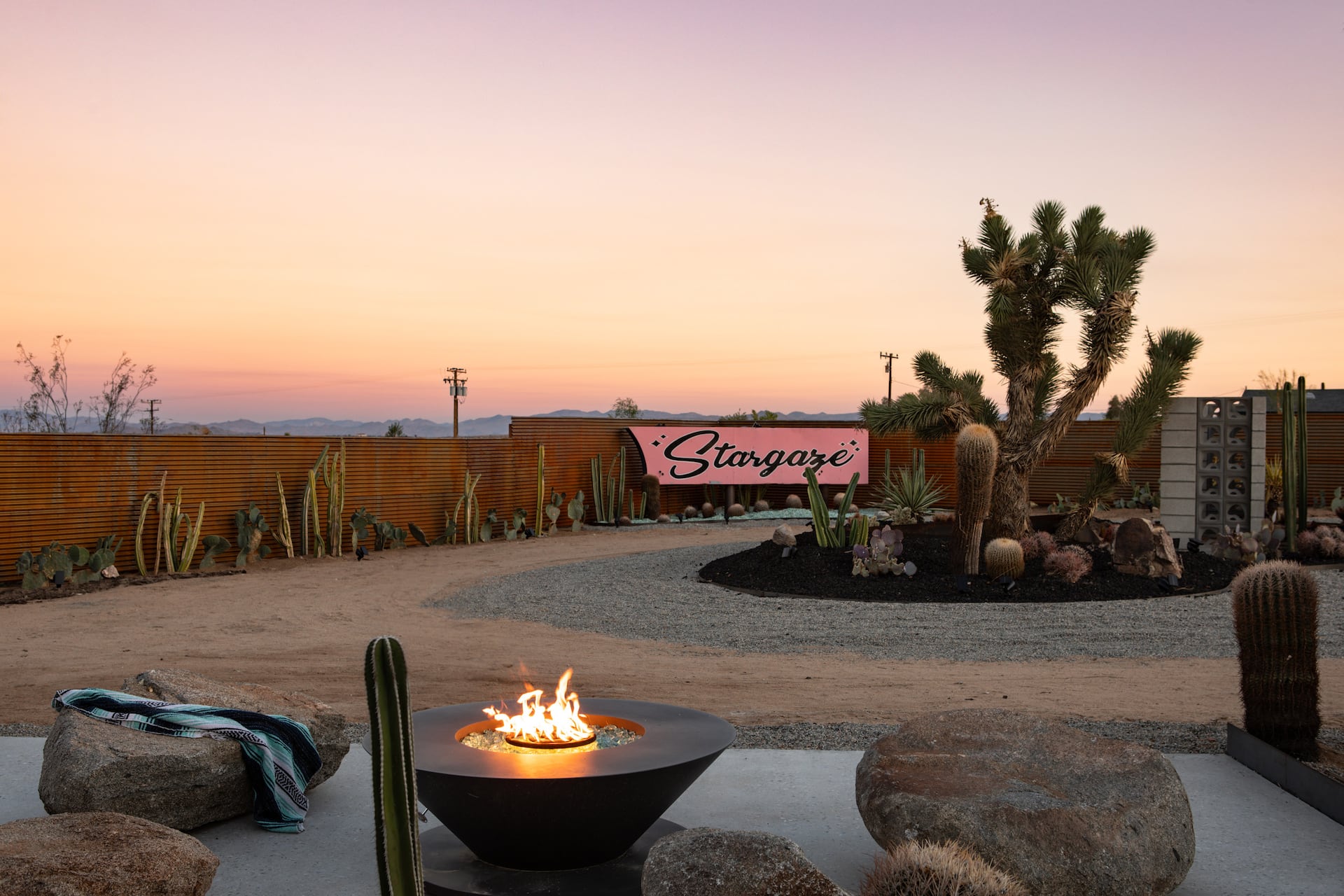
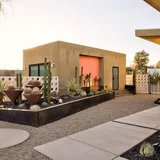
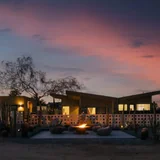
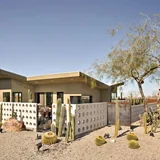
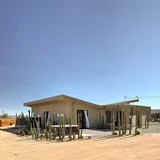
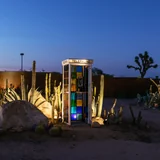
You don't have to drive into the park to see spring colour, either. The lot at Stargaze Escape is landscaped with thousands of cacti, agave and Joshua trees, and some of them flower in spring. Wherever you are — the garden here or the Cholla Cactus Garden in the park — the rule is the same: look, photograph, and leave the plants and rocks exactly as you found them. Removing anything from the park is prohibited, and the cacti here are best admired with your hands in your pockets. For a fuller rundown of what blooms and where, our wildflowers guide goes species by species.
The Best Spring Hikes
Mild spring temperatures open up the whole trail network, including the longer climbs that are punishing in summer. A few worth putting on the list, from short to strenuous.
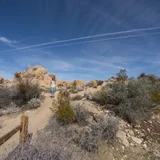
For an easy leg-stretch, Hidden Valley is a one-mile loop that gains about 100 feet and circles a rock-enclosed basin once rumoured to have hidden cattle rustlers. Barker Dam is a similar easy loop of about 1.1 miles with roughly 50 feet of gain; it passes a historic water tank and a petroglyph site, and after a wet winter the dam can actually hold water in spring, which comes and goes, so it is worth checking. Skull Rock is an easy loop of about 1.7 miles past the skull-shaped boulder near Jumbo Rocks, and Arch Rock is an easy loop of about 1.4 miles out to a natural granite arch — there is a much shorter spur to the arch from the White Tank campground if you would rather cut it down.
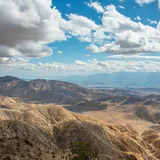
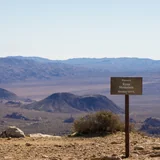
For something with a view, Ryan Mountain is the classic: a strenuous 3-mile round trip that climbs about 1,050 feet to a summit near 5,457 feet, with one of the best panoramas in the park. Keys View asks nothing of you at all — it is a drive-up overlook at about 5,185 feet with a short paved loop, looking out over the Coachella Valley, the San Andreas Fault, the Salton Sea and the San Jacinto and San Gorgonio peaks. In between, Split Rock is a moderate 2.5-mile loop that winds among boulder piles, and Mastodon Peak is a moderate loop of about 3 miles that passes the old Mastodon Mine and tops out with Salton Sea views. Both are good spring lengths, enough to feel like a hike without committing to a big-mileage day.
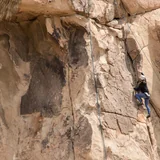
If you want a long day while the weather allows it, the mine and oasis hikes are the ones to save for spring. Lost Horse Mine runs either as a 4-mile round trip to a well-preserved stamp mill, about 550 feet of climbing, or a 6.8-mile loop, about 900 feet. Fortynine Palms Oasis is a strenuous 3-mile round trip listed at about 300 feet of gain, though it crosses a ridge, so you climb more than that number suggests. The park closes this trail every year from June 1 through September 30, so do it by the end of May. The longest of the bunch, Lost Palms Oasis, is about 7.5 miles round trip from Cottonwood Spring out to the park's largest palm oasis.
A few things hold true no matter which trail you pick. There is no water anywhere in the park interior, so bring your own — a common guideline is at least a gallon per person per day, and more in the warmer weeks. Cell reception inside the park is very limited and should not be relied on, so download offline maps before you go. And even in spring, start early: you will beat both the heat and the worst of the parking crowds. Our hiking guide has more detail on each of these.
Joshua Trees in Bloom
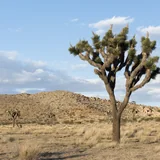
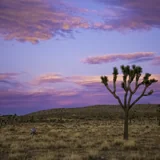
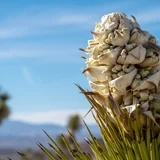
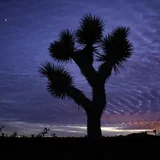
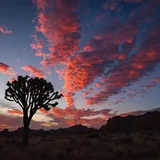
Spring is also when the Joshua trees themselves may flower, and it is worth understanding what that does and doesn't mean. Joshua trees bloom with creamy clusters at their branch tips somewhere between mid-February and April — but only in years with well-timed rainfall and a crisp winter freeze to set it off. They do not flower every year, and the intensity varies a lot from tree to tree and season to season. If you catch a good bloom, it is a matter of luck as much as timing.
The plant itself is stranger than it looks. Despite the name it is not a true tree at all — it is a yucca, Yucca brevifolia, which modern DNA places in the agave family. It has no growth rings and no true wood, which is part of why nobody can give it an exact age. What is known is that it grows slowly, somewhere between half an inch and three inches a year, and lives around 150 years on average, with some individuals estimated at over 300. Mature trees can top 40 feet, and rare giants approach 50. A young Joshua tree won't flower until it is roughly 50 to 70 years old, at around eight feet tall.
The flowers exist because of a single insect. Joshua trees are pollinated only by the yucca moth, in a relationship neither species can live without: the moth deliberately packs pollen onto the flower and lays its eggs in the ovary, so the moth's young get food and the tree gets its next generation. No moth, no seeds.
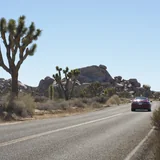
It is worth appreciating them while they are here. Joshua trees grow across the Mojave in parts of California, Arizona, Utah and Nevada, but they are slow to recover from damage and poorly adapted to wildfire, and a warming climate is squeezing their range — some models project the species could be largely lost from the park it is named for within about a century. The trees on the lot here, and the ones lining the road out to the west entrance, are part of that same wider forest. If you want the fuller story of how they live and why they matter, we wrote about the Joshua tree on its own.
Longer Days by the Pool
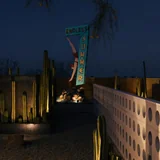
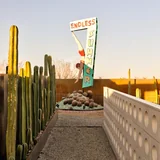
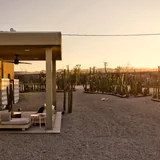
One of the quiet luxuries of a spring trip is daylight. The light runs later every week, which means you can hike in the morning, come back to the house through the warm middle of the day, and still have hours of evening left. After a dusty trail, the stock-tank pool is where most afternoons end up. It sits under a vintage painted "Endless Summer" metal sign, with a star-perforated steel privacy screen around it, and it warms through the season as the days lengthen.
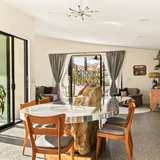
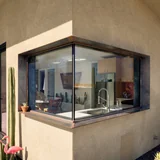
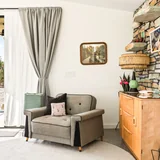
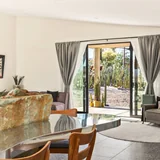
The private hot tub is open all year, so even in early spring when the pool is still cool, there is a warm place to sit as the temperature falls after sunset. Inside, a freestanding soaking tub sits by a wide window onto a private courtyard, for the days you would rather stay in. The whole lot is fully fenced, which makes the afternoon feel like your own.
One guest wrote that the house has "photo-worthy spots everywhere." The low gold light of a spring afternoon earns it.
A couple of practical notes for the water: no glass anywhere near the pool or hot tub, and quiet hours start at 10pm, so wind the evening down gently. When you would rather cook than drive back into town, there is a full kitchen and an outdoor BBQ grill, and dinner outside as the light goes long is hard to beat. You can see more of the pool and hot tub if you are weighing it up.
Spring Nights and the Sky
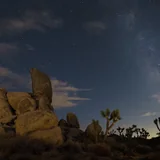
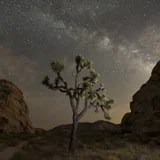
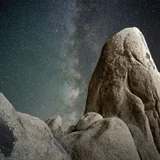
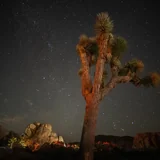
Joshua Tree was designated an International Dark Sky Park in 2017, at the Silver tier — dark enough, in the park's interior, to reach roughly Bortle 2 to 3 on the nine-point darkness scale, where the structured band of the Milky Way shows to the naked eye. That said, where you stand matters: the edges of the park and the western entrances are brighter, and the darkness varies, so treat the Bortle figure as a rough guide.
Each season has its own sky. Spring evenings bring Leo overhead, the galaxy-rich Virgo and Coma region with its cluster of distant galaxies, Boötes with the bright star Arcturus, and the Big Dipper riding high. The bright core of the Milky Way is only just returning in spring — early in the season it sits low in the southeast just before dawn, so you catch it before sunrise rather than after dinner. By summer it climbs into the evening sky.
Your eyes do a lot of the work if you let them. It takes about 20 to 30 minutes in the dark for your night vision to come in, and a single glance at a phone screen resets it, which is why a dim red light is the right tool for finding your way. Spring nights are still cool, sometimes cold, so bring a layer if you plan to be out a while.
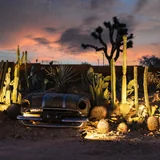
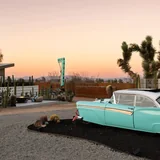
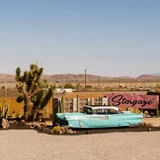
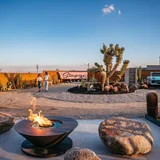
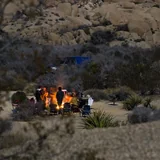
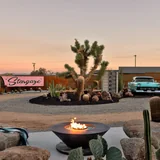
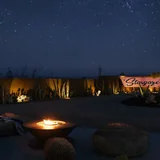
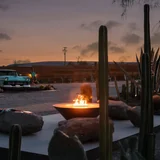
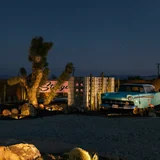
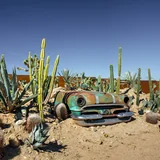
You do not have to go anywhere for this. The restored 1950s car on the gravel has been turned into an open-air bed with a custom stargazing roof that can be pulled back, which makes it a good place to lie back and watch the sky. The gas fire pit, ringed by natural boulders, gives you somewhere warm to sit without the glare of a wood fire washing out your night vision. Keep in mind the 10pm quiet hours, and keep your own lights low so the dark stays dark. For what to look for month by month, see our piece on the night sky over Joshua Tree.
Spring Crowds and the Busy Weekends
The trade-off for spring's easy weather is that it is the park's busiest season. March through May draws the biggest crowds of the year, both for the mild days and for the chance of wildflowers, and holiday weekends are busier still. The good news is that the park does not use a timed-entry reservation system as of 2026 — you can drive in whenever you like. The less good news is that the popular trailheads and the entrance stations back up in the middle of the day.
The single best move is timing. The West Entrance, at Joshua Tree Village about five miles south of the Highway 62 and Park Boulevard junction, is the busiest of the park's gates. From the house it is about a 25-minute drive, close enough that getting there early, before the mid-morning rush, is realistic. If the west gate is backed up, the North Entrance in Twentynine Palms is an alternative. Late afternoon, once the day-trippers head out, is another quiet window, and it lines up nicely with the good evening light.
It is also worth thinking midweek if you can. Weekends carry the heaviest traffic, and a Tuesday-to-Thursday spring stay feels markedly calmer at the trailheads than a Saturday. If you plan to be in the park several days, the Joshua Tree annual pass runs about $55 and pays for itself against the roughly $30 seven-day vehicle fee before long — though, like all the park's fees, it is worth confirming the current price before you go.
A couple of dates to watch, too. The park publishes a handful of fee-free days each year, and in spring those often include Presidents Day in February and Memorial Day in late May — good for saving the vehicle fee, but they pull bigger crowds, so plan around them. Those dates change every year, so check the current-year list before you count on one. April also brings the big music festivals down in the Coachella Valley, and their weekends fill hotels and roads across the region; if your trip overlaps, expect more traffic on Highway 62. We put together a guide to basing here during festival weekends if that is your plan.
A Two-Night Spring Plan
Here is a loose two-night shape that makes the most of the season without cramming it.
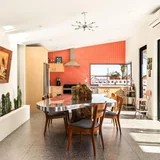
Arrive in the late afternoon and settle in first. The house sleeps four across two king bedrooms, so a spring weekend suits a couple, two couples, or a small group. Stop for groceries on the way through Yucca Valley — there are full grocery stores right on Highway 62 — since there are no shops or restaurants inside the park. Cook the first night on the BBQ grill, get the fire pit going once it cools off, and let your eyes adjust for a first look at the stars from the car bed.
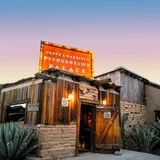
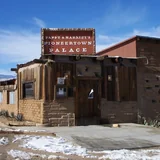
Give the first full day to the park. Head in early through the west entrance, do a longer hike while it is cool — Ryan Mountain or one of the oasis trails — and pair it with a couple of the short roadside stops like Skull Rock or the Cholla Cactus Garden. Come back to the house for the warm part of the afternoon, swim in the stock-tank pool, and either cook in again or head out for dinner. Pappy & Harriet's in Pioneertown is the well-known choice for barbecue and live music. For a daytime meal, La Copine, out in the Flamingo Heights stretch, is a destination lunch spot, open Thursday to Sunday from 11am to 4pm, though hours change, so check before you go.
Keep the second day slower and closer to home. This is the day for the town side of the trip: coffee in Yucca Valley or downtown Joshua Tree, the Saturday morning farmers' market if your dates line up, and a wander through the shops before checkout. If you would rather not move much at all, the soaking tub, the hot tub and the pool are right there. There is far more to do than two days can hold — the area fills in the rest.
What to Pack for Spring
Spring packing is mostly about the temperature swing between day and night. A few things earn their place in the bag:
- Layers. A warm afternoon can follow a near-freezing morning in early spring, so bring a jacket or fleece you can peel off as the day heats up.
- Sun protection. The high-desert sun is strong even when the air is mild — a hat, sunglasses and sunscreen go a long way.
- Water, more than you think. There is none in the park interior, so carry at least a gallon per person for a full day out, plus a bottle for the car.
- Sturdy shoes. Most park trails are natural dirt and sand over uneven rock, not paved paths.
- Offline maps and a red light. Cell service is thin in and around the park, so download maps before you arrive; a red flashlight or headlamp keeps your night vision for stargazing.
- A swimsuit. The hot tub is open all year and the pool warms through spring.
If you are bringing a dog, a few extra rules apply. The house is dog-friendly, though cats can't come due to a household allergy. The park itself keeps dogs off all hiking trails and out of the backcountry — they are allowed only within 100 feet of roads, parking areas and campgrounds, always on a leash no longer than six feet. Bring waste bags, a water bowl and their own bed. And remember the no-glass rule around the pool and hot tub when you pack drinks. Our full packing list for the high desert covers the rest of the year too.
Booking a Spring Stay
Spring is the mild, bright window when the desert does the most: active wildlife, the chance of flowers, long light and comfortable trails. It is also the most in-demand season, so dates go early and the best weekends fill first. Check availability, look up the park's current wildflower report for the week you are eyeing, and book your spring stay at Stargaze Escape.