





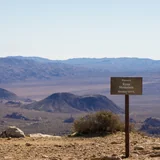
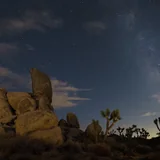



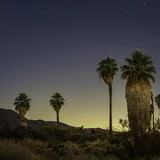










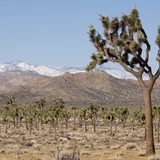
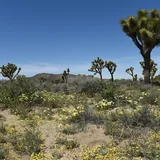
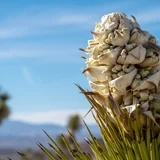
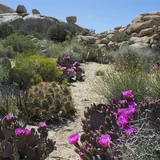








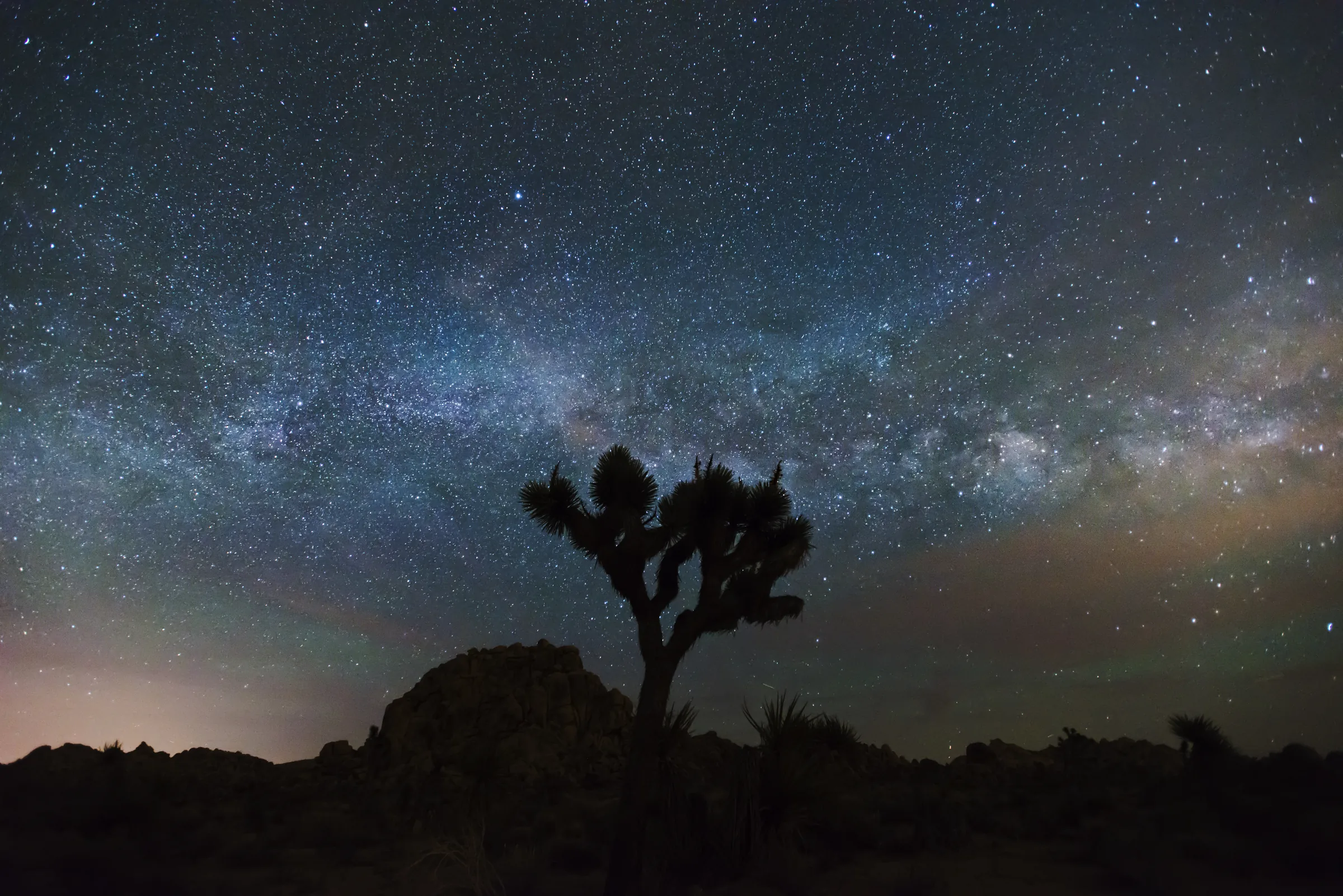
Desert Sky
The Night Sky Over Joshua Tree
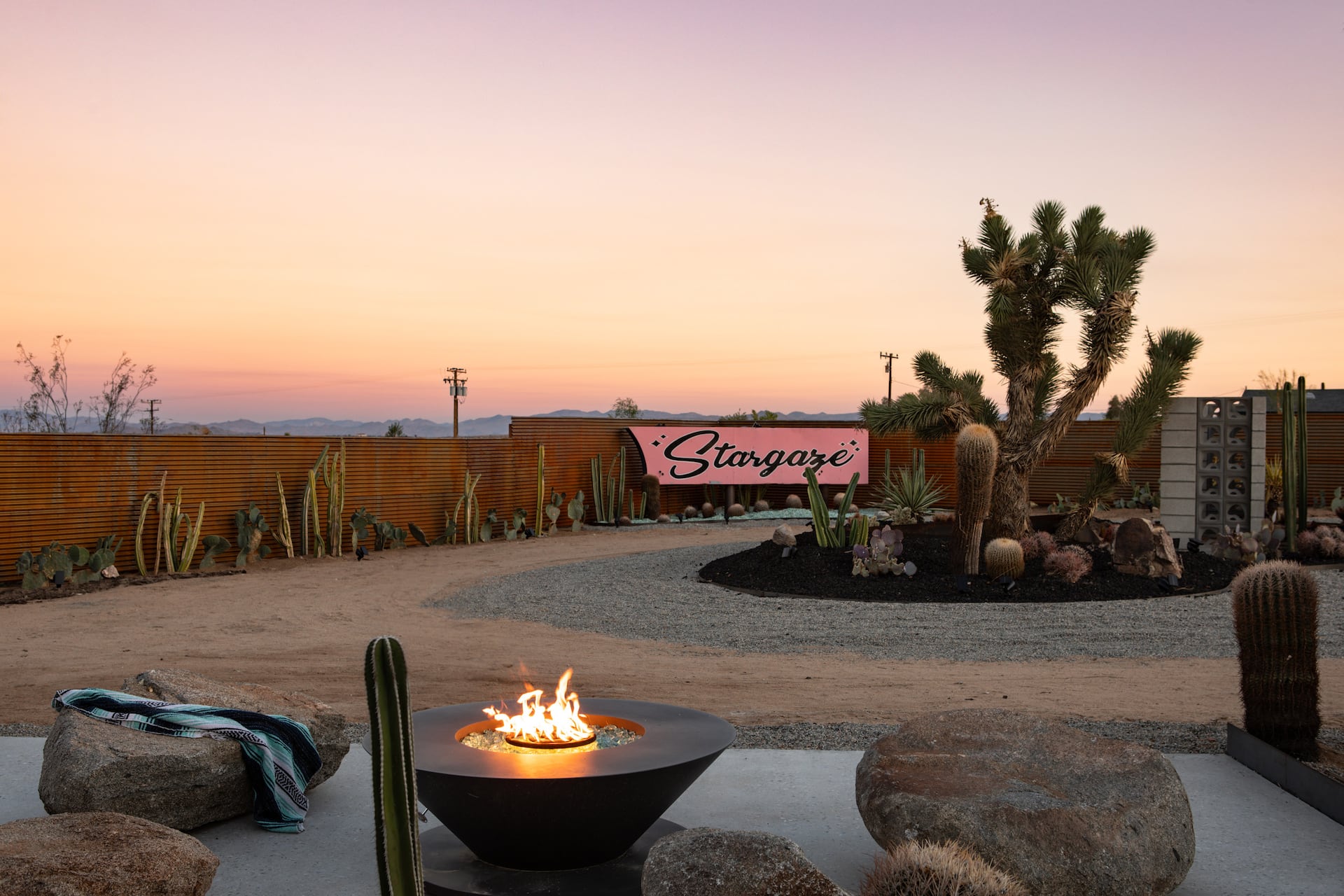
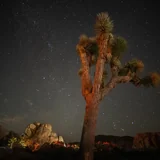
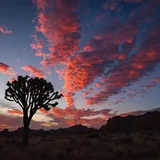
Step outside into the yard after the last color drains from the western hills, wait a few minutes, and the sky fills in with far more stars than most people ever see from home. Joshua Tree National Park, about a 25-minute drive from the house, is a certified dark-sky park, and the same dry high-desert air hangs over our fenced lot in Yucca Valley. This is a guide to what turns overhead through the seasons, how to actually see it, and where on the property to lie back and look up.
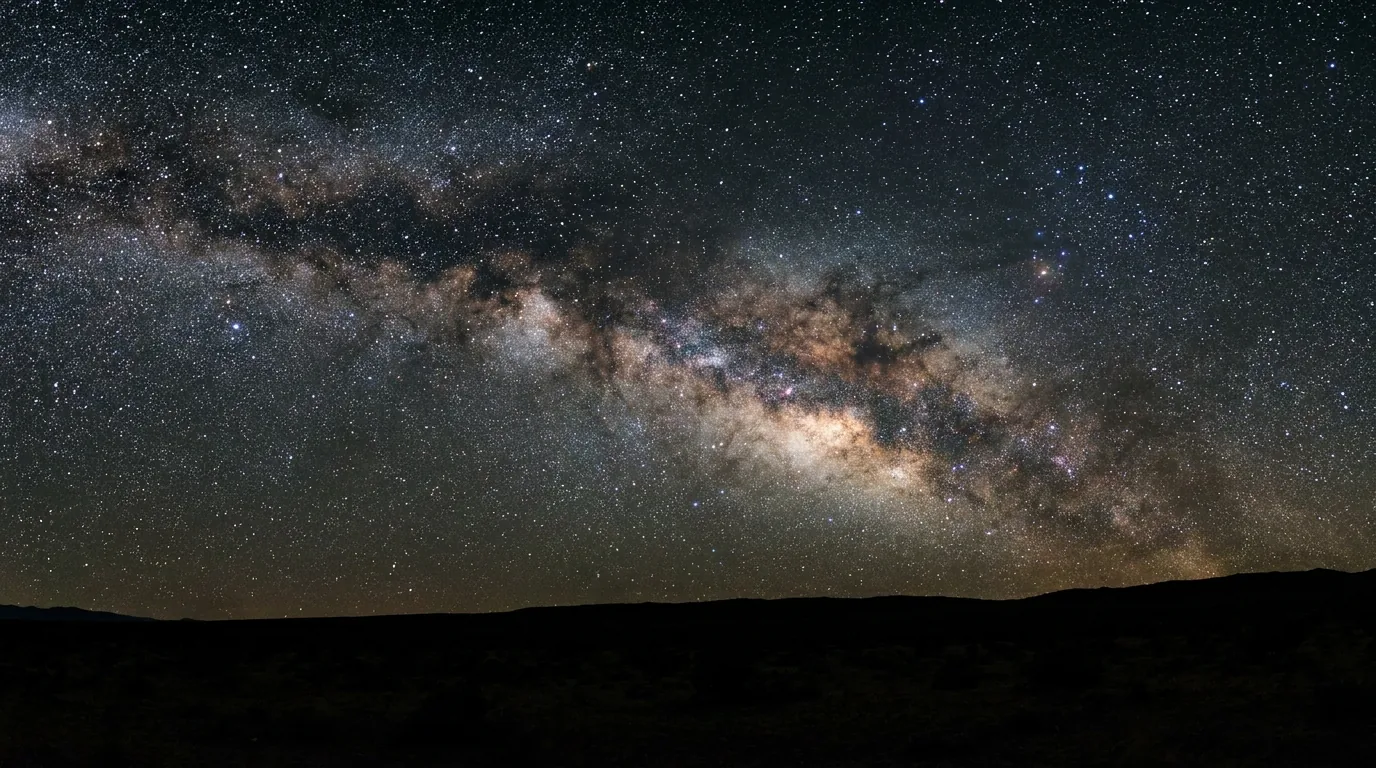
Why the sky here is so dark
Joshua Tree was named an International Dark Sky Park in 2017 by the group now called DarkSky International, with the plaque accepted at a ceremony that August. It carries the Silver Tier of that designation, which means excellent dark skies that still catch a little glow from the cities around the desert. Three things combine to keep it dark: the park sits a long way from any major city, it stands at high-desert elevation, and the air out here is dry and clear for most of the year. Yucca Valley itself is around 3,300 feet up, and that height, along with the low humidity, is a big part of why the stars look so sharp.
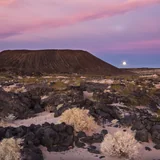
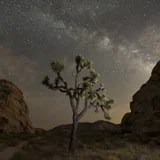
You will still see faint domes of light on the horizon. The brightest come from the Los Angeles basin to the west, the Coachella Valley and Palm Springs to the south, and Las Vegas off to the northeast. Look away from those, toward the darker interior of the park, and the sky opens up. In the darkest parts of the park the conditions reach roughly Bortle Class 2 to 3 on the nine-step scale astronomers use — dark enough that the banded structure of the Milky Way, the soft airglow near the horizon, and the faint cone of zodiacal light after dusk all show to the naked eye. That Bortle figure shifts depending on exactly where you stand; the areas near the park boundaries and the western entrances run brighter, so treat it as a rough guide rather than a fixed number.
The dark-sky title takes ongoing work to earn and keep. Parks qualify partly by controlling their own lighting — shielding fixtures, aiming light downward, keeping it warm in color — and by monitoring sky quality over the years. Joshua Tree has geography on its side too. It straddles two deserts, the higher, cooler Mojave across the west and north and the lower, hotter Colorado in the east and south, and most of the park is open backcountry with nothing out there to light it. That mix of protected darkness and wide, dry terrain is why a clear night here looks the way it does.
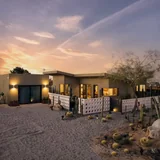
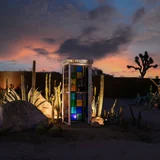
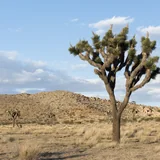
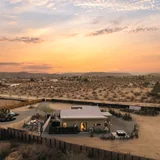
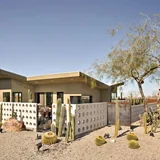
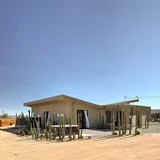
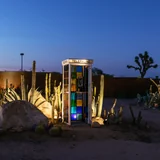
The house sits on the Yucca Valley side, near the west end of the basin, so you will notice some town glow low to one horizon. The yard is fenced and planted with cactus and Joshua trees rather than lit up, which helps. If you want to understand how much a single porch light matters out here, our note on keeping the night dark walks through the small choices that protect it.
How to let your eyes adjust
The single biggest change you can make to a night of stargazing costs nothing. Human eyes need roughly 20 to 30 minutes in the dark to reach good night vision, and they keep getting more sensitive well beyond that. The catch is that one glance at a white phone screen or a bright flashlight resets the whole process, and you start the clock over again.
So the routine is simple. When you come outside, turn off any nearby lights, settle into a chair or lie down, and give it time. Keep your phone in your pocket, or switch it to its dimmest red night mode if you need it. Experienced observers carry a small red flashlight for reading a star chart or finding a dropped lens cap, because red light lets you see your feet without wrecking the dark adaptation you have built up. A headlamp with a red setting is worth packing.
It helps to know what you are waiting for. In the first few minutes you will see the brightest stars and planets. After ten minutes more stars fill in. After twenty to thirty, the Milky Way turns from a vague smudge into a textured band with dark lanes running through it. Patience is the whole trick. Pour a drink, get comfortable, and let the sky come to you rather than hunting for it right away.
One more trick worth knowing is averted vision. The center of your eye is built for daylight and color; the edges are far more sensitive to dim light. So when you are trying to catch a faint object like a distant galaxy or the soft glow of a nebula, look slightly to one side of it rather than straight at it, and it will often appear. It feels backward at first and becomes second nature quickly.
The winter sky
Winter, roughly December through February, brings the showiest set of bright stars of the year, and the crisp cold air often makes them look even sharper. The centerpiece is Orion, the hunter, striding up the eastern sky in the evening. Hanging below the three stars of his belt is the Orion Nebula, catalogued as M42 — a stellar nursery you can spot as a faint fuzzy patch with the naked eye and resolve into a glowing cloud with binoculars.
Follow Orion's belt down and to the left and you reach Sirius, in Canis Major, the brightest star in the entire night sky. It often twinkles through colors low over the horizon. Up and to the right of Orion sits Taurus, the bull, and riding on the bull's shoulder is the Pleiades, M45 — a tight little cluster of blue stars that many people mistake for a tiny dipper. Most eyes catch six or seven of them; the desert dark often reveals more. Overhead through the winter you will also find the twins of Gemini, the bright pentagon of Auriga, and little Canis Minor.
If you want a name for the whole winter arrangement, those brilliant stars — Sirius, the shoulders of Orion, the eye of Taurus, a star each in Gemini and Auriga, and a few others — form a large ring called the Winter Hexagon that dominates the southern sky on a January evening. It is the richest patch of bright stars the year offers, and the desert cold, uncomfortable as it is, tends to steady the air and sharpen every point of light.
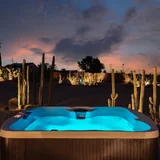
The Milky Way is still up in winter, but this is the faint outer edge of the galaxy, the anti-center, so it arches overhead as a dim band rather than the bright core of summer. Winter is the quiet, cold season out here. Nights routinely drop into the 30s and 40s Fahrenheit and can reach freezing, so this is the season to watch from the hot tub, which stays open all year, or to bundle up with a blanket by the gas fire pit. Bring layers you would not expect to need; the desert gives up its daytime heat fast once the sun is down.
The spring sky
Spring, from about March through May, swings the sky toward galaxies. Leo, the lion, climbs high in the evening with the bright star Regulus at the base of a backward question mark of stars called the Sickle. East of Leo lies the richest patch of galaxies visible from the northern hemisphere, the Virgo and Coma region, home to the Virgo Cluster and a long list of Messier galaxies. Most of these are faint smudges that reward binoculars or a small telescope under skies this dark, but knowing they are there — whole other galaxies, their light millions of years old — changes how you look at that empty-seeming stretch of sky.
Higher up, the Big Dipper rides overhead as part of Ursa Major, the great bear, and its two end stars point the way to Polaris, the north star. Follow the curve of the Dipper's handle and you arc down to Arcturus, the warm orange beacon in Boötes, one of the brightest stars in the spring sky. Keep following that same curve past Arcturus and you carry on to Spica, the blue-white star of Virgo — stargazers remember it as "arc to Arcturus, then speed on to Spica." Late in the season, in the hours before dawn, the bright core of the Milky Way begins to return low in the southeast, a preview of the summer show.
Spring is the park's busiest stretch, tied to the wildflower season and mild days in the 65 to 80 Fahrenheit range. Nights are comfortable enough that you can lie out for a long while without freezing. When you want the very darkest view of that returning galaxy core, it is worth a short drive into the park proper; our dark-sky stargazing guide covers where to pull off and what to expect once you are inside the boundary.
The summer sky and the Milky Way core
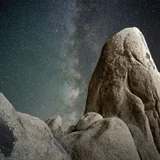
Summer is the season people picture when they imagine desert stargazing, and it earns the reputation. From roughly June through August the bright core of the Milky Way — the dense, dusty center of our galaxy — climbs into the southern sky during the late evening. Under the dark air here it is not subtle: a broad, textured band, bright enough to stop most people in their tracks the first time they see it under a dark sky.
To find the heart of it, look south and low for Scorpius, the scorpion, marked by the red supergiant Antares glowing at its chest. Just east of the scorpion sits Sagittarius, whose brightest stars form a shape most people recognize as a teapot. The spout of that teapot points almost exactly at the center of the galaxy, and the "steam" rising from it is the thickest, brightest part of the Milky Way. Sweep that whole area slowly with binoculars and you will drift past star clouds, clusters, and glowing nebulae one after another.
Directly overhead in summer hangs the Summer Triangle, three bright stars in three different constellations: Vega in Lyra, Deneb in Cygnus the swan, and Altair in Aquila the eagle. Cygnus lies right along the Milky Way, so the band runs straight through the Triangle. Give yourself time on a moonless summer night and the band will seem to grow as your eyes deepen their adaptation, until the dark rift — the lane of cold dust that splits the glow lengthwise — stands out clearly.
Summer days are hot out here, often topping 100 Fahrenheit, which makes summer the park's quietest season, but the nights stay warm in the 60s and 70s, comfortable for lying out for hours. Cool off in the stock-tank pool after dark and then look up; the water holds some of the day's warmth and the sky is at its best. If you are building a trip specifically around the stars, our stargazing at the house page lays out how the yard is set up for it — dark corners, places to recline, and a clear view up.
The autumn sky
Autumn, September through November, is a quieter, more contemplative sky. Its headline object is the Andromeda Galaxy, M31, the most distant thing you can easily see with the naked eye — a faint oval of light whose glow left it about two and a half million years ago. Under the dark air here you can find it without optics once your eyes are adapted; through binoculars it grows into a clear elongated smudge. Andromeda hangs high in the evening, tucked below the Great Square of Pegasus, a large, plain box of four stars that is easy to learn and useful for finding everything nearby.
Overhead, look for the flattened W of Cassiopeia, the queen, which sits on the opposite side of Polaris from the Big Dipper and rides high on autumn evenings. Between Cassiopeia and Pegasus runs Perseus, worth sweeping with binoculars for its double cluster of stars. Early in autumn the Milky Way core is still visible in the evening sky, though it sets earlier each week and fades from the show by late in the season.
Autumn nights cool off pleasantly and the crowds thin after the summer heat, which makes it one of the better times to lie out for a long session. It is also the season you may notice a tarantula ambling across the gravel at dusk; in fall these wanderers are almost always harmless males out looking for a mate, and the park service describes them as timid. If a meteor streaks past while you are watching — autumn has its showers — our post on watching meteor showers from the car bed covers how to make a night of it.
The planets and the moon
Five planets are bright enough to see without any equipment, and telling them apart is one of the first skills worth learning. Venus is the easiest: brilliant and steady, low in the west after sunset or in the east before dawn, brighter than any star. Jupiter is the next brightest and holds a creamy, steady light; a cheap pair of binoculars held very still will show its four largest moons as tiny dots in a line. Mars glows a distinct reddish-orange. Saturn looks like a modest yellowish star to the eye, though even a small telescope reveals its rings. Mercury is the shy one, only ever low near the horizon in the glow of dawn or dusk, and gone within an hour.
The important thing about planets is that they move. Which ones are visible, and whether they are morning or evening objects, changes from month to month and year to year, so there is no honest way to promise a particular planet on a particular night. Before your trip, check a free sky app such as Stellarium or a planner like PhotoPills for your exact dates; it takes a minute and tells you what will be up and where to look. A planet is at its brightest around what astronomers call opposition, when the Earth passes between it and the sun and it stays up most of the night — but those dates differ for each planet and each year, which is one more reason to check ahead.
The moon is the other moving piece, and it matters more than anything else for what you will see. A bright, near-full moon floods the sky and washes out all but the brightest stars — lovely for walking the yard without a flashlight, though poor for the Milky Way. If you want the galaxy at its best, plan your trip around the new moon, or the nights on either side of it, when the sky is darkest. A full-moon visit has its own quiet pleasures, which we get into in full-moon nights at the house. Check the moon phase for your dates the same way you check the weather.
Ranger programs and the Night Sky Festival
You do not have to figure the sky out alone. Park rangers run free night-sky programs through much of the year, and they range from the basics — reading a star chart, learning to identify a handful of constellations — to deeper astronomy talks and presentations on light pollution and dark-sky stewardship. The schedule is seasonal and gets posted by the park, so check the current calendar when you know your dates.
The biggest event is the annual Night Sky Festival, held in the fall, usually over several nights in October. Southern California astronomy clubs bring telescopes for public viewing, and there are guided sky tours, talks, and cultural programming across the weekend. It is a ticketed event, the dates and ticketing change every year, and it tends to sell out, so if it is on your list, look it up early on the park's event page rather than relying on last year's dates. There is also a community observatory over near Twentynine Palms that runs public star parties of its own; its calendar shifts, so check ahead before driving out.
A few practical notes for any night trip into the park. It is open 24 hours a day, every day of the year, and there is no timed-entry reservation to drive in — the gates stay open even when the entrance stations are unstaffed at night. The entrance fee runs around $30 per vehicle for a seven-day pass, though park fees change, so confirm the current rate before you go. Cell service inside the park is unreliable, so download an offline map beforehand, bring plenty of water, and top off your gas in town, since there are no services inside. Our guide to the local observatory has more on organized viewing nearby.
A beginner's astrophotography setup
The desert sky here practically asks to be photographed, and you can get a real Milky Way shot with modest gear if you know the starting points. The classic setup is a camera that shoots in manual mode, a wide and fast lens — something in the 14 to 24mm range at f/2.8 or wider — and a sturdy tripod, because every shot is a long exposure. From there, a common starting recipe is a high ISO of somewhere around 1600 to 6400, the aperture wide open, and a single exposure of roughly 15 to 25 seconds. Treat those as a place to begin rather than fixed settings; the right numbers depend on your lens, your camera's sensor, and how dark the sky is that night.
The length of that exposure is governed by a handy shortcut called the 500 rule. The stars are always moving, or rather the Earth is turning under them, and if your shutter stays open too long they blur into short trails. The rule estimates the longest safe exposure as 500 divided by your focal length in millimeters, on a full-frame camera. A 20mm lens, then, gives you about 25 seconds before the stars start to streak. If your camera has a smaller crop sensor, divide by the crop factor first, and if you want the crispest pinpoint stars, some photographers use a stricter version, the 300 rule, instead.
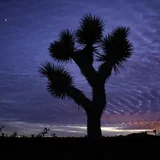
A few field habits make the difference between a snapshot and a keeper. Focus manually on a bright star, zoomed in on your screen, since autofocus fails in the dark. Shoot on a new-moon night for the darkest sky. Put something in the foreground — a Joshua tree, a boulder, the silhouette of the house — so the image has depth and a sense of place. Use your red light so you do not blind yourself between frames. If you shoot several frames of the same scene, free software can stack them to smooth out the grain that high ISOs produce and give a cleaner result than any single exposure, though that is an optional next step. And do not overlook a modern phone: many now have a night mode that, propped steady, will capture more of the sky than you would guess. One guest review of the property mentioned "photo-worthy spots everywhere," and the yard after dark is no exception.
Watching from the car bed
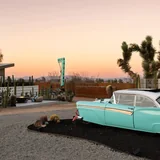
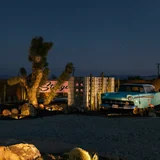
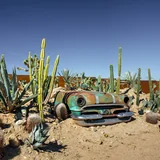
The most comfortable place on the property to watch all of this is out on the gravel. A restored 1950s car has been rebuilt into an open-air bed, parked in the yard, with a custom stargazing roof that can be pulled back, so you can lie flat and take in the whole sky without craning your neck. The metalwork that turned the car into a bed was done by Emerick's Ironworks. With the roof pulled back and a couple of blankets, it becomes a place to watch Orion climb in winter or the Milky Way arc over in summer.
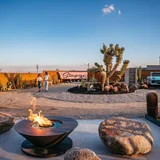
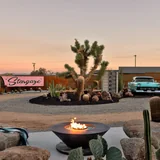
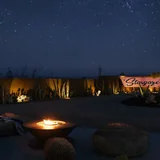
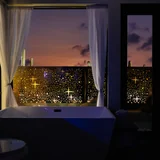
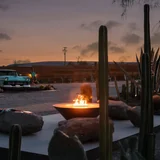
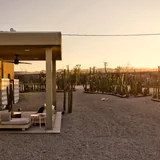
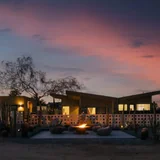
Around the yard there are a few other spots to settle in. The gas fire pit, ringed by natural boulders, throws enough warmth to sit out on a cold night — it burns gas, so there is no smoke to sting your eyes or drift across the view. There is a private hot tub that stays open year-round, and the stock-tank pool sits behind a steel privacy screen that is perforated with a pattern of stars, so even the screen around the water plays along with the theme. More on those warm-water evenings lives on our fire and stars page.
A word on being a good desert neighbor while you are out there. Quiet hours start at 10pm, so keep voices low late at night — sound carries a long way in the open desert, and the dark and quiet are the whole point. No glass near the pool or hot tub. Dogs are welcome here, and a calm dog is good company on a starry night. If the car bed is the part of the trip you are most curious about, we wrote its whole story up in the car bed post.
Planning your night
Here is the short version to plan around. Come on nights near the new moon if the Milky Way is your goal, and check the moon phase the way you would check the forecast. Dress far warmer than you expect in winter, when nights reach freezing, and bring layers even in summer for the hours after midnight. Download an offline star app before you lose signal, give your eyes a full 20 to 30 minutes to adjust, and keep a red light handy. Then stop hunting and lie back, and let the sky do the rest.
The darkest skies are a short drive into the park; the easiest ones are a few steps from the door here. When you are ready to pick your nights, check the moon phase for your dates and book your stay around the new moon for the best shot at the Milky Way.