

























Month by month
Joshua Tree in October
October is when Joshua Tree's busy season begins. Afternoon highs ease into the high 70s and low 80s, the Fortynine Palms closure and the campfire ban are due to end on the first of the month, climbers come back to the rock, and the Morongo Basin's calendar fills with open artist studios, a music festival, a town celebration and the park's Night Sky Festival. Book early if your dates touch one of those weekends.
How warm October gets
At NOAA's Yucca Valley climate station, about 3,250 feet up, the 1991-2020 normals give October an average high of about 80°F and an average low of about 50°F. The month cools steadily: the normal high starts near 85°F on October 1 and ends near 74°F on October 31, and the normal low falls from about 54°F to about 46°F. The station's daily readings for 2011 to 2020 average three or four days at 90°F or more in October, and NOAA's normals count a freezing night only about once every five years.
Down at NOAA's Twentynine Palms station by the North Entrance, roughly 1,275 feet lower, October averages about 85°F by day and 58°F at night, and its daily readings for 1991 to 2020 average around 11 days at 90°F or more. On the coldest night of a typical October it falls to about 43°F there, and its October records run from 106°F down to 24°F. Expect afternoons in the park to land between those two stations, and mornings at the higher trailheads to start cool.
Rain stays light. Yucca Valley's October average is about 0.6 inch, though NOAA counts fewer than one day in an average October with a tenth of an inch or more, so most years see little; Twentynine Palms averages 0.15 inch. October still sits inside the park's flash flood season, which it gives as July to October, so a storm forecast deserves attention.
Shorter days
October takes away a little over an hour of daylight. In Yucca Valley the sun rises around 6:39 am and sets around 6:31 pm on October 1. By the 15th it's about 6:50 am and 6:13 pm, and on the 31st about 7:04 am and 5:55 pm, which leaves just under 10 hours 52 minutes of light. Daylight saving time lasts the whole month (in 2026 the clocks fall back on November 1), so evenings still feel long on the clock. Full darkness comes around 7:35 pm in mid-October and around 7:18 pm on the last night of the month.
On busy days the park asks visitors not to leave right after sunset, because exit traffic tends to spike then. If you want sunset inside the park, bring dinner and stay for the first stars while the traffic clears.
What changes on October 1
Several summer rules end with September. The trail to Fortynine Palms Oasis, shut from June 1 to September 30 each year under the superintendent's compendium, is due to reopen. The park's trailhead page says the summer closure can stay in place until monsoon rains refill the water sources, so check alerts before you drive out. The park lists the trail at 3 miles out and back, with about 300 feet of climbing in each direction. In October it's still best started early.
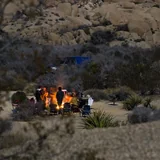
The summer ban on campfires and grilling, in force since June 15, is due to lift on October 1 as well, unless the park declares a period of high fire danger, so check the alerts before you plan a campfire. Collecting wood in the park is prohibited, so buy firewood in town. Under the compendium, campground loops that close for the hot months can stay shut until the weekend before Columbus Day (October 12 in 2026), though that year Belle and White Tank were scheduled to reopen on August 28. The Black Rock Nature Center in Yucca Valley keeps its regular hours of roughly 8 am to 4 pm with an hour's break around midday.
Climbing season
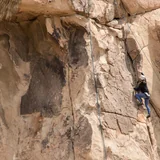
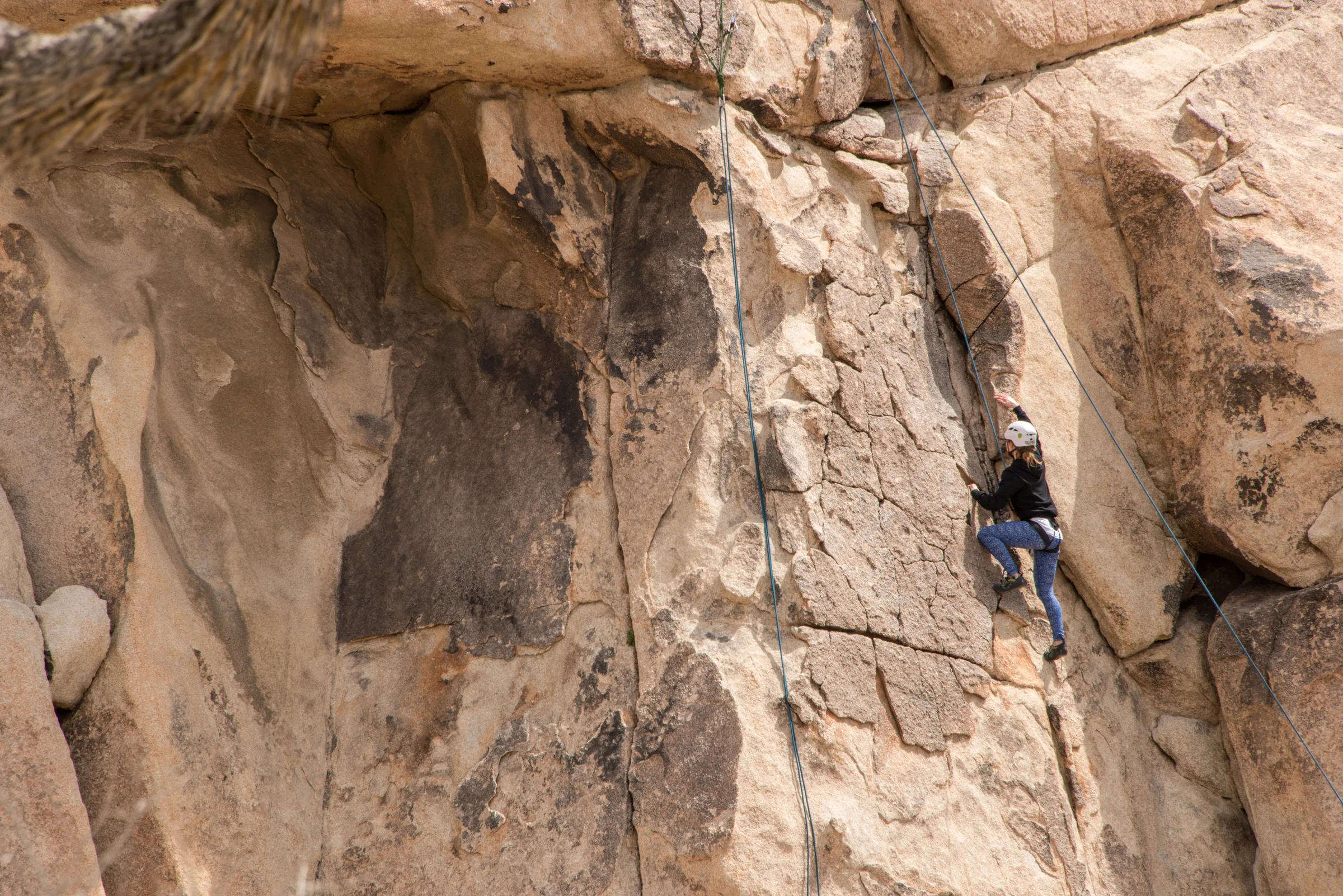
October is when the climbers return. By the park's count, Joshua Tree's monzogranite holds more than 8,000 climbing routes and 2,000 boulder problems, and the Mountain Project area guide describes the main season as October through April, with October and March normally the best months. Locals climb all year.
A few park rules apply. Placing, replacing or removing any fixed anchor needs a permit, and the park posts climbing closures on its climbing page, so check them before you go. The park's Climber Coffee morning meetups are listed for Saturdays and Sundays from January through March, so don't expect them in October; check the park calendar. Our rock climbing guide has more on climbing in the park.
Crowds and timing
The National Park Service counted 233,697 recreation visits in October 2023 and 212,097 in October 2024. October 2025 came in lower, at 163,674. A federal government shutdown began that month, and a local tourism-board notice from October 1 said the park was open with limited services and staffing and wasn't collecting entrance fees. The counts don't say why the number fell, so treat that October as an outlier rather than a trend. In each of those years November was busier again, by a third or more.
The park's busy season runs from October through May, and weekends fill first. Its advice for those days is to arrive before 8 am and to buy your pass on Recreation.gov before you arrive. The West Entrance in the town of Joshua Tree, the closest to the house, is the busiest; the North Entrance in Twentynine Palms and the South Entrance off Interstate 10 are quieter. The lots at Hidden Valley, Barker Dam, Keys View, Split Rock and Lost Horse Mine can close temporarily once full, and the park suggests reaching Barker Dam and Hidden Valley before 9 am.
Columbus Day weekend, October 10 to 12 in 2026, is the month's federal holiday weekend, and that year it overlaps both the music festival and the Night Sky Festival. October 27, Theodore Roosevelt's birthday, is on the park's 2026 list of fee-free days, which the park says apply to U.S. citizens and residents.
The October night sky
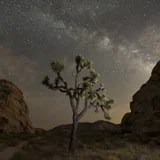
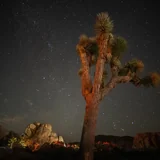
The park's Night Sky Festival is held each fall, usually in October, mainly at Sky's the Limit Observatory & Nature Center on Utah Trail, just outside the North Entrance and roughly 40 minutes from the house. The 2026 festival was set for October 9 and 10, beside that month's new moon on October 10. Its program mixed free events, such as an astronomy lecture series and a Friday glow party, with paid ones: a Friday telescope clinic at $30, a Saturday family space camp at $25 per child, and the Saturday night star party at $75 for adults and $35 for children. It's ticketed with limited capacity, and tickets usually go on sale in early summer. The park suggests bringing a red flashlight and warm clothes. Our guide to Sky's the Limit covers its programs the rest of the year.
The Orionids follow. The American Meteor Society's 2026 calendar has them active from October 2 to November 7, peaking on the night of October 21 to 22. In a normal year they produce 10 to 20 meteors an hour at their best; between 2006 and 2009 they reached 50 to 75. The society's 2026 calendar shows a 74 percent moon on peak night, which will hide the fainter meteors while it's up. Most showers are best between midnight and dawn, and a waxing gibbous moon sets in the early morning hours, so the last dark stretch before sunrise is the time to watch.
Two smaller showers overlap. The Southern Taurids' annual peak falls around October 14, and the Northern Taurids begin on October 20; the society notes that when both run together in late October and early November, bright meteors can become more frequent. The 2026 full moon comes on the evening of October 25. In 2027 the full moon falls on October 15 and the new moon on October 29, which leaves the end of that October darker.
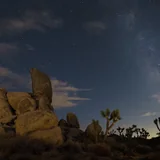
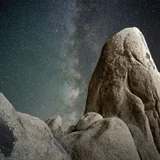
Look up between meteors and the autumn constellations are high after dark. Find the Great Square of Pegasus, follow it toward Andromeda, and a pair of binoculars will show the Andromeda Galaxy as a soft oval. The Milky Way's bright core is low and setting early by now, and it leaves the evening sky almost entirely by late November.
Art, music and a town festival
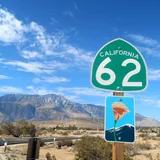
The Hwy 62 Open Studio Art Tours, run by the Morongo Basin Cultural Arts Council, open artists' studios across the basin over the first three weekends of October: October 3 and 4, 10 and 11, and 17 and 18 in 2026. You plan your own route with the tour's app, and an evening program called Art Tours After Dark adds music. Our high desert art trail covers galleries you can visit the rest of the year.
The fall Joshua Tree Music Festival takes over Joshua Tree Lake Campground, about 16 miles from Yucca Valley by way of Sunfair Road. The 2026 edition, its 21st in the fall, was set for October 8 to 11, with music on three stages from 10 am to 2 am, more than 100 workshops, a children's area called Kidsville, and walk-in tent camping included with every ticket. The campground closes to other guests that week. The Joshua Tree Gem and Mineral Show used the same grounds just before it (September 30 through October 4 that year).
In Twentynine Palms, Pioneer Days marks its 90th year in 2026, set for October 15 to 18 with a parade, a 5K and the town's outhouse races; that year's theme celebrates 100 years of the Old Schoolhouse. Down in Palm Springs, about 50 minutes away, the fall edition of Modernism Week was scheduled for the same dates with more than 50 events on midcentury architecture and design, and the Palm Springs Aerial Tramway was scheduled to reopen on October 5 after its annual maintenance. Dates move every year; our high desert events calendar lists what usually happens when.
Packing for October
- Layers for a 30-degree swing. A t-shirt for an 80-degree afternoon and a fleece or light puffy for a 50-degree evening.
- A warm hat and jacket for night events. The Saturday star party at the 2026 Night Sky Festival was scheduled to run until 11 pm.
- A red flashlight. Or a headlamp with a red mode, so you don't spoil anyone's night vision at a telescope.
- Binoculars. For Andromeda, the Pleiades rising later in the evening, and birds by day.
- Sun protection and water. The sun is still strong, and the park suggests at least a gallon of water per person per day.
- Climbing gear, if you climb. October is the start of the season, so bring your own rack and plan around the busy lots.
At the house in October
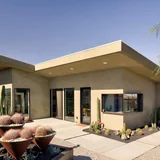
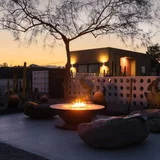
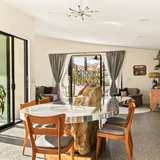
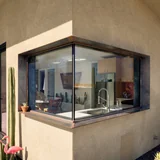
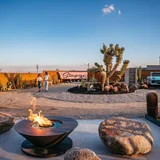
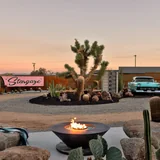
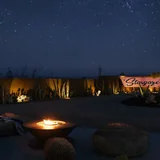
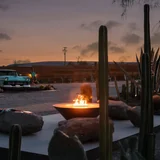
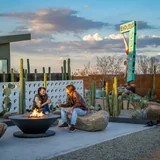
Cooler evenings make the gas fire pit the center of the night. It's ringed by natural boulders and runs on gas, so there are no logs to buy or carry, and it's an easy place to end a day of studios or climbing. The hot tub is private and open in every season, and the indoor freestanding soaking tub sits by a wide window onto a private courtyard, a good way to warm up after a pre-dawn meteor watch.
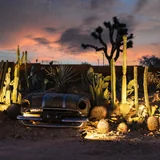
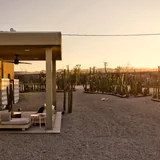
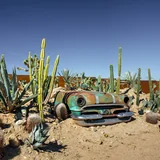
Early in the month, warm afternoons still suit the stock-tank pool, and the house has both air conditioning and heating to cover a warm midday and a cool dawn. Out on the gravel, the car bed (a restored 1950s car, now a bed under its custom stargazing roof) makes a fine spot for the Orionids if you're up before sunrise. With a full kitchen, an early breakfast before an 8 am park entry takes no effort.
Know before you go
- Fortynine Palms is scheduled to reopen on October 1, but the park says the reopening date changes year to year. Check the park's alerts first.
- The park's first-come weekend campsites are typically full by Friday afternoon from now through May; reservable sites open up to six months ahead.
- Festival weekends book up early. If your trip depends on the Night Sky Festival or the music festival, buy tickets before you plan the rest.
- Entrance passes run around $30 per vehicle for seven days, except on fee-free days such as October 27 in 2026 (for U.S. citizens and residents).
- Daylight saving time ends on the first Sunday of November, so late-October evenings are the last long ones of the year.
- Nights can fall into the 40s even when the afternoon reached 80°F.
Check October dates early if you want a festival weekend, and when you're ready for the cooler month that follows, read Joshua Tree in November.
Keep exploring
Joshua Tree in January
Joshua Tree in January: NOAA weather normals for Yucca Valley, short days, snow and road closures, crowd numbers, the Quadrantids and Palm Springs events.
Read →
Joshua Tree in February
Joshua Tree in February: Yucca Valley weather normals, longer days, the start of spring crowds, Joshua tree blooms, Modernism Week and Mars and Jupiter in 2027.
Read →
Joshua Tree in March
Joshua Tree in March: the park's busiest month, NOAA weather normals, the clock change, mid-elevation wildflowers, spring wind, the night sky and local events.
Read →