














Travel tips
Gas and EV Charging near Joshua Tree
There are no gas stations or EV chargers inside Joshua Tree National Park, so every day in the park starts with a full tank or a good charge from the towns along Highway 62. This guide covers where to fill up and plug in around Yucca Valley and Joshua Tree, how far the usual park drives run, and how to plan fuel for longer desert day trips. Stations, prices and charger counts change, so check a current app or map before you rely on any single stop.
No fuel inside the park
There are no hotels, restaurants or gas stations in the park, so go in with enough food, water and gas or electric charge for the day. The park is open around the clock, and the gates stay open at night when the entrance stations aren't staffed, which makes it tempting to head in for sunset or the stars on a low tank. Resist it.
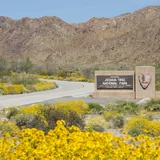
All the fuel is outside the boundary, in the gateway towns. The West Entrance is five miles south of Highway 62 on Park Boulevard in Joshua Tree village. The North Entrance is three miles south of the highway on Utah Trail in Twentynine Palms. The South Entrance sits off Interstate 10 near Cottonwood Spring, about 25 miles east of Indio. For passes and which gate suits which day, see our guide to Joshua Tree entrances and fees.
How far the park drives run
Distances inside the park add up faster than the map suggests, because the main roads are long and the exits are few. These are rough round-trip figures from a mapping service:
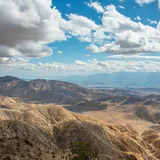
- Keys View and back. About 42 miles from the Joshua Tree Visitor Center in the village, a little more from the house. Our Keys View guide covers the overlook itself.
- Across the park on Park Boulevard. In through the West Entrance, out through the North Entrance and back along Highway 62 comes to roughly 60 miles.
- The long south loop. From the village to the Cottonwood Visitor Center through the park is about 54 miles one way. Coming home by Interstate 10 and Highway 62 rather than retracing your route makes the whole day roughly 140 miles.
The park also puts the North Entrance about 25 miles east of the West Entrance by road. None of these drives is long for a full tank, but they stack up on a day when you've also driven in from Los Angeles, or when you add a second trip in for sunset. Waiting counts as well: the park calls the West Entrance its busiest and says it often has long lines, and an engine running the air conditioning in a slow line burns fuel without going anywhere.
Gas in Yucca Valley
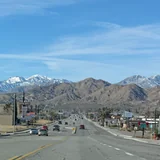
Yucca Valley has the most choice, and filling up here before you head east means you won't think about fuel again that day. You'll pass several stations along Highway 62 through town, about 15 minutes from the house; a map app will show which are open and what they charge. The same stretch of highway holds a Stater Bros. and a Vons, so one stop can cover fuel, drinking water and lunch for the cooler. Our guide to groceries and supplies in Yucca Valley has the details.
Gas in Joshua Tree village and Twentynine Palms
The last fuel before the West Entrance is in Joshua Tree village, on Highway 62 near the Park Boulevard turn. At last check, GasBuddy listed a Valero at 61794 29 Palms Highway, and the station is sometimes described as the last chance for gas before the park. From there it's five miles up Park Boulevard to the entrance station, and nothing to buy after that until you leave the park.
If you're entering or leaving by the North Entrance, fill up in Twentynine Palms on Highway 62 before you turn south on Utah Trail. Twentynine Palms is about 40 minutes from the house, and it's also home to the Joshua Tree National Park Visitor Center and the Oasis of Mara, with the Fortynine Palms Oasis trailhead just west of town, so a fuel stop fits naturally into that side of the trip.
The south side and Interstate 10
The South Entrance is where running low can turn into a long detour. It leads out to Interstate 10 about 25 miles east of Indio, and the Cottonwood Visitor Center sits about seven miles north of the freeway. Indio is the nearest city with plenty of stations. East of the park's freeway exit, Chiriaco Summit is a long-running travel stop with a gas station and a store, plus the General Patton Memorial Museum, which tells the story of the desert training camps Patton set up nearby in 1942. Keep its hours in mind and check them before you count on it. If you're planning the full south loop, start it with a full tank. Our guide to Cottonwood Spring and Mastodon Peak covers that end of the park.
Fast charging along Highway 62
For an electric car, the Morongo Basin is better supplied than its size suggests, with fast chargers along Highway 62 in Yucca Valley and Joshua Tree. These are the ones we could confirm, roughly from west to east:
- Tesla Supercharger, Yucca Valley. 16 stalls at up to 250 kW in Desert Hills Plaza, 57220 to 57274 Twentynine Palms Highway, open 24 hours since 2022. Charging databases list it as open to other EVs; cars with a CCS port need an adapter, and drivers without a Tesla membership pay a higher rate.
- EVgo at Warren Vista Center. 57677 29 Palms Highway, Yucca Valley. DC fast charging at up to 350 kW on CCS plugs, open 24 hours since January 2024. Cars with a Tesla-style port need an adapter.
- Rivian Joshua Tree Charging Outpost. 61142 29 Palms Highway in Joshua Tree village. It opened in December 2024 with 12 fast chargers (8 CCS and 4 NACS) at up to 300 kW, and any EV can charge there by paying through the Rivian app. The lounge lists hours of 8am to 5pm daily, with free coffee from Joshua Tree Coffee Company, wifi, restrooms, hammocks and a kids' play area with a climbing wall. Charger databases show the plugs as available around the clock, but confirm in the app before a late arrival.
- Tesla Supercharger, Twentynine Palms. At Tortoise Rock Casino, 73829 Baseline Road, handy before or after the North Entrance. Charging databases list this one for Tesla vehicles only, so other EV drivers should plan on Yucca Valley or Joshua Tree.
Level 2 charging and the park visitor center
Slower Level 2 chargers make sense while you're doing something else for an hour or two. The park's Joshua Tree National Park Visitor Center at 6533 Freedom Way in Twentynine Palms lists EV charging stations, and the center is open 8am to 5pm at last check, so you can top up while you look at the exhibits and refill water bottles at its filling station. In Yucca Valley, charger databases list Blink chargers at the library on 29 Palms Highway and at the welcome center at 56711 Twentynine Palms Highway, which the park also names as a place to buy an entrance pass. Confirm in a charging app that they are working before you build a plan around them.
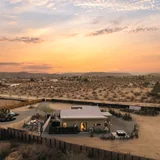
The house has free parking, but EV charging isn't on its list of amenities, so plan on the public chargers above. The Yucca Valley chargers are about 15 minutes from the house and the Rivian outpost in Joshua Tree about 20, so a charging stop on the way home from the park fits easily around a grocery run.
Planning range in the desert
This landscape changes how far a tank or a battery goes. Highway 62 climbs a long way from Interstate 10 up to Yucca Valley, which sits at about 3,300 feet, and the park keeps going up from there: Keys View is at about 5,185 feet. Uphill miles use more energy. An EV wins some of it back on the way down, but don't plan on getting it all back. The park itself runs from 536 feet in its far southeast corner to 5,814 feet on Quail Mountain, so the long south loop drops to the low desert and then climbs all the way back.
Temperature matters as well. Summer days here commonly reach the mid-90s to over 100°F, when the air conditioning works hard, and winter nights can fall to freezing, when cabin heat and a cold battery both cut an EV's range. Add the time spent with the engine or climate control running at viewpoints and in entrance lines. A sensible habit is to enter the park with enough fuel or charge to do your planned drive twice, and to top up in town on the way home rather than the next morning.
Gas drivers have one more reason to keep the tank high. The park warns against trusting GPS onto backcountry roads, and if something goes wrong on a remote stretch you may sit for a while waiting for help, with the engine running for air conditioning or heat. Phone signal is thin out there too, which is why our notes on desert safety and Leave No Trace suggest leaving your plan with someone before you go.
Fuel on longer day trips
Some of the best drives from the house cross country with even fewer services than the park. Mojave National Preserve has no gas at all. The park service lists the nearest stations at Baker, at Cima Road and Interstate 15, and in Primm, Searchlight, Fenner, Amboy and Ludlow, and it warns that running out of fuel in the preserve is a frequent and costly mistake. Before a day at the dunes, read our Mojave Preserve and Kelso Dunes guide and leave the Morongo Basin with a full tank.
The drive north to Amboy on old Route 66 is the same story on a smaller scale. Amboy appears on the park service's list of fuel stops near the preserve, but plan to fill up in Twentynine Palms before you set out rather than relying on it. Our Amboy Crater and Route 66 guide covers the route. For an EV, check the charging map along the whole route before you go, since fast chargers thin out quickly once you leave Highway 62.
Know before you go
- Inside the park. No gas, no charging and no food for sale. Enter with a margin.
- Last fuel before the West Entrance. Joshua Tree village on Highway 62, five miles from the gate.
- North Entrance. Fill up in Twentynine Palms before you turn onto Utah Trail.
- South Entrance. Indio to the west or Chiriaco Summit to the east on Interstate 10. Check Chiriaco's hours.
- Fast charging. Tesla and EVgo in Yucca Valley, Rivian (open to all EVs through its app) in Joshua Tree, Tesla only in Twentynine Palms.
- Adapters. Bring yours. Several sites offer only one plug type.
- At the house. Free parking; no EV charger on the amenity list.
- Check the day you go. Charger status and station hours change, so look at PlugShare or the network's own app.
Once the tank is sorted, the rest of the day is easy. Check dates at the house, then pick your first loop through the park.
Keep exploring
Hospitals and Urgent Care near Joshua Tree
Where to get medical help near Joshua Tree: the ER in Joshua Tree, trauma care in Palm Springs, urgent care, pharmacies, vets and the park's emergency phones.
Read →
Cell Service in Joshua Tree
Cell service in Joshua Tree National Park is very limited. Where to find wifi, how to set up offline maps, and how to reach help by satellite or text.
Read →
Ideas for Hot, Windy or Rainy Days
Too hot, windy or wet for the park? Indoor and cooler options around Yucca Valley, Twentynine Palms and Palm Springs, plus heat, wind and flash flood facts.
Read →