

















Joshua Tree
The Story of the Joshua Tree
Almost everyone who comes out here asks the same question somewhere on the drive in: what actually is a Joshua tree? It is the plant that gave the national park, the town seven miles down Highway 62, and this whole stretch of high desert their name, and a few of them grow on the lot at Stargaze Escape. What follows is a plain account of the plant itself, the moth that keeps it going, how it grows, when it flowers, where the finest stands are, and why the century ahead of it is harder to read than the trees make it look. For a wider view of the region around the house, our area overview sets the scene.
Not a tree at all
The Joshua tree is Yucca brevifolia, and despite the name it is not a tree in any botanical sense. It is a yucca, a giant member of the monocots, which is the same broad group of plants that includes the grasses and the orchids. For a long time botanists shuffled the yuccas between plant families, but modern DNA work places the Joshua tree in the agave family, Asparagaceae. So the closest relatives of the thing standing beside the road are agaves and other yuccas, not oaks or pines.
The distinction matters to more than botanists. A real tree grows a ring of new wood every year, which is how you count the age of an oak from a stump. A Joshua tree has neither true wood nor growth rings. The trunk is a dense mass of fibers held together by tiny bundles that run up through it, and the outside is a rough, corky bark rather than the hard timber of a pine. As a monocot it has no cambium layer to lay down fresh wood and widen its girth the way a broadleaf tree does, which is another reason there are no rings inside it. This is the single most important fact about the plant, because it means nobody can cut one open and count the years. Every age you will ever read for a Joshua tree, including the ones in this post, is an estimate.
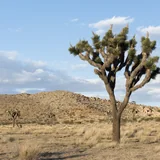
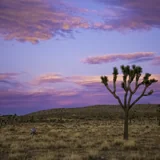
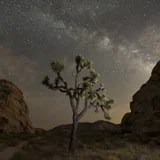
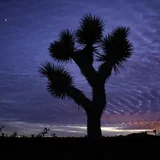
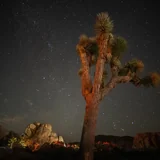
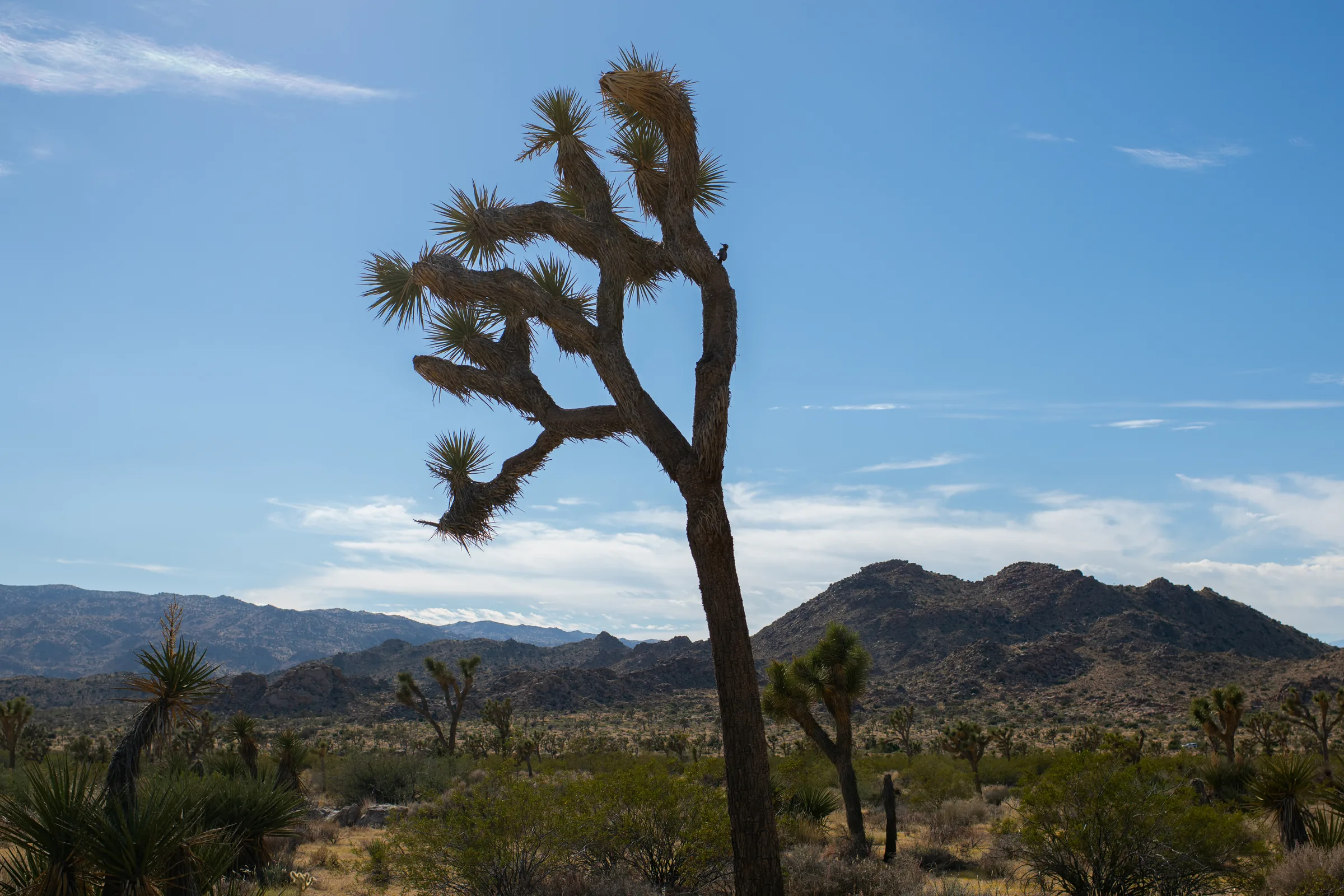
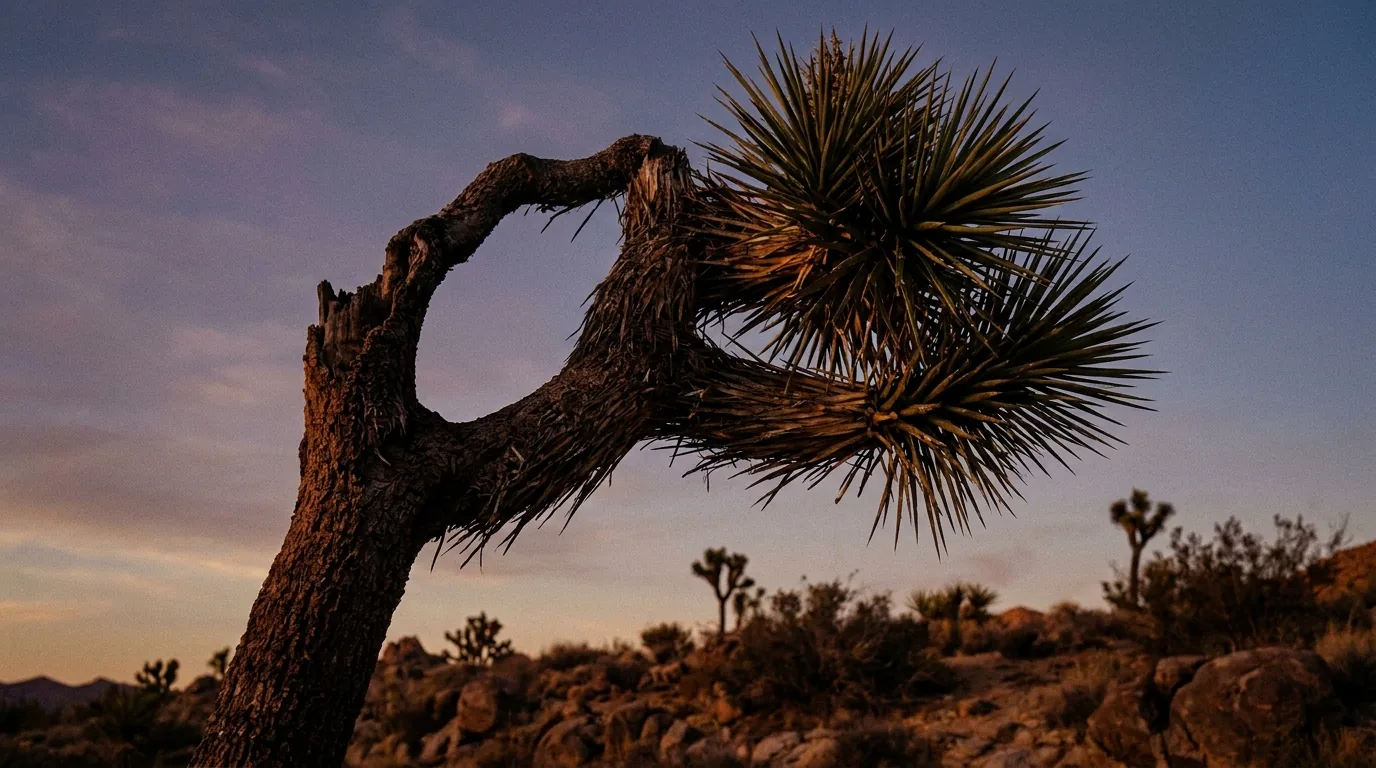
Up close the plant reads clearly as a yucca. The branches end in dense clusters of stiff, spine-tipped leaves, each one short and shaped like a dagger, gray-green and sharp enough to draw blood if you walk into one in the dark. That short leaf is where the scientific name comes from, and it is also the easiest way to tell a Joshua tree from its cousin the Mojave yucca, Yucca schidigera, which grows in the same country but carries much longer, wider leaves low to the ground and rarely lifts itself into the branching, top-heavy silhouette that makes the Joshua tree so recognizable from a moving car. The Joshua tree is the tallest and most tree-like of the yuccas, which is exactly why it fools people into calling it one. The branching crown of arms, held out at angles that no two trees repeat, is the shape everyone photographs, and it is the reason a stand of them can look like a crowd frozen mid-gesture at dusk.
The name
The scientific half of the name is settled and literal. Brevifolia is Latin for short-leaved, a description any visitor can confirm by looking at the stubby blades at the end of a branch. The common name is a different matter, and it is worth being honest about how little is actually known.
The story usually told is that Mormon travelers crossing the Mojave in the middle of the nineteenth century looked at the outstretched limbs and saw the biblical figure Joshua raising his arms, and that the name stuck from there. It is a good story and you will hear it from guides, on signs, and in most guidebooks. It is also folklore. There is no firm contemporary record that pins the name to a specific group of settlers or a specific moment, so treat it as the tale people tell rather than documented history. What is certain is that the name spread far enough to attach itself to almost everything out here.
The plant named the park. Joshua Tree was first protected as Joshua Tree National Monument on August 10, 1936, set aside by President Franklin D. Roosevelt after a long campaign led by the Pasadena conservationist Minerva Hoyt; the original monument covered roughly 825,000 acres. It was redesignated Joshua Tree National Park on October 31, 1994 under the California Desert Protection Act, which also widened its boundaries to somewhere north of 790,000 acres today. The town of Joshua Tree, the one just up the road with the coffee roaster and the old diner, carries the plant's name too, and so does much of the tourism that now flows through the Morongo Basin. One slow-growing desert yucca ended up lending its name to a federal park the size of a small state and to the community at its gate. It is a rare case of a single plant becoming the identity of an entire region, printed on maps, storefronts, and highway signs alike.
The moth it depends on
The most remarkable thing about a Joshua tree is easy to miss: it cannot make a single seed on its own. It is pollinated only by the yucca moth, in what biologists call an obligate mutualism, which is a plain way of saying that neither partner can get by without the other.
Here is how the arrangement works. When a Joshua tree flowers, a female yucca moth visits the creamy blossoms and gathers pollen into a ball, which she carries in specialized mouthparts shaped for exactly this task and then deliberately packs onto the flower's stigma. She is not doing this by accident on furry legs the way a bee blunders from bloom to bloom; she does it on purpose. Then she lays her eggs inside the flower's ovary, right among the seeds that her pollinating has just set in motion. When the eggs hatch, the larvae feed on some of those developing seeds. Enough seeds are left over to grow into the next generation of trees, and enough young moths crawl away to become next year's pollinators. The moth secures food for her young, and the tree secures its future.
Neither the Joshua tree nor its moth can reproduce without the other. It is one of the tightest partnerships in the desert, and it is the reason a flowering year matters so much.
The pollination happens at night, when the moths are active and the pale flowers show up best in the dark, which is one more reason the whole cycle turns on a single well-timed season. Take away the moth and the tree sets no seed; take away the tree and the moth has nowhere to lay its eggs. This is a textbook case of two species that have shaped each other so closely they now hold each other's survival, and it is why the health of the moth matters as much as the health of the tree. It is also why the timing of a bloom is not a small thing. A tree that never flowers in a dry stretch of years produces no seeds at all, no matter how healthy it looks standing there. If you would like to meet more of the creatures that make this partnership possible, our field guide to Mojave wildlife runs through the moths, lizards, birds, and mammals you are most likely to notice on a stay.
How it grows and how old it gets
Joshua trees grow slowly, and it is worth sitting with just how slowly. A healthy plant puts on somewhere between about half an inch and three inches of height in a year, depending on rainfall and its own vigor. That is roughly the growth of a fingernail over a season for the slower ones. The tall, many-armed specimens you photograph did not get that way in a human lifetime; many were already standing when the first homesteaders arrived. The big wave of five-acre desert homesteads under the Small Tract Act filled Wonder Valley and the wider Morongo Basin in the 1950s and 1960s, and plenty of the trees those settlers built their cabins around were already old then.
Because there are no growth rings to count, every figure here is an estimate rather than a measured age. The National Park Service gives an average lifespan of around 150 years, with some individuals thought to live more than 300. Mature trees can stretch over 40 feet tall, and a rare giant approaches 50 feet. A young Joshua tree does not even flower until it is roughly 50 to 70 years old, by which point it stands somewhere around eight feet tall. In other words, a Joshua tree that is old enough to reproduce is older than most of the buildings in the nearest town. Because there is no ring to read, researchers estimate a tree's age instead from its height and from measured growth rates, which is why you will see the same tree described as anywhere from a century to several centuries old depending on who is doing the counting. These are all soft numbers, so treat them as ranges, and if you want a current sense of the oldest and tallest trees, the park's own information is the place to check.
The slow clock has a hard consequence. When a Joshua tree is damaged, whether by a careless boot, a vehicle, or a fire, it does not bounce back in a season or two the way a fast-growing shrub does. Recovery, where it happens at all, is measured in the same slow inches. That single fact sits underneath everything else in this guide, from how to behave around the plants to why their future is uncertain.
When it blooms
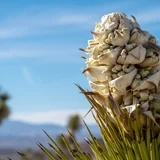
In a good year, a Joshua tree pushes out heavy clusters of creamy, greenish-white flowers at the ends of its branches, usually somewhere between mid-February and April. A tree in full bloom is a real event. Flowering is uncommon here, and a blooming tree means the yucca moths have work to do.
The catch is in the word uncommon. Joshua trees do not flower every year. A bloom seems to need two things to line up: well-timed winter rain, and a crisp winter freeze that appears to act as a trigger. In years when the weather does not cooperate, whole stands stay green and quiet through the spring. Even in a flowering year, how heavy the bloom is varies widely from place to place and tree to tree. There is no calendar date you can circle in advance and count on, so if seeing the trees in flower is high on your list, check the park's current wildflower and bloom updates close to your trip rather than trusting any fixed month.
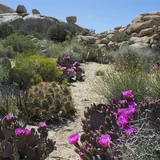
The Joshua tree bloom is only one act in a longer desert spring. Down at lower elevations the wildflowers and cactus flowers follow their own rain-dependent schedule, and our guide to high-desert wildflowers lays out what tends to open when, with the same caution that a big year is the exception, not the rule. A strong wildflower spring generally needs about half an inch of rain in a single storm followed by evenly spaced follow-up rain, and true super-bloom years come along only once every several years, so a flowering Joshua tree in a good wildflower season is a lucky bit of timing rather than a sure thing.
The two deserts of the park
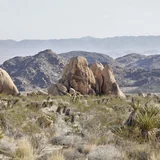
One reason Joshua Tree National Park feels like two places is that it straddles two deserts. The higher, cooler Mojave Desert covers the western and northern part of the park, and that is Joshua tree country, along with the Mojave yuccas. The lower, hotter Colorado Desert covers the eastern and southern part, and there the Joshua trees drop away and give up the ground to ocotillo, cholla, and creosote. The park protects the transition band between the two, which is why you can see plants from both deserts inside one boundary. Elevation is the quiet reason for the split. Joshua trees favor the higher, cooler ground of the Mojave, roughly the same band of country that Yucca Valley sits in at around 3,300 feet, and they thin out and disappear as the land falls away into the hotter basins to the south and east.
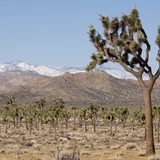
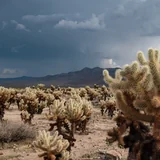
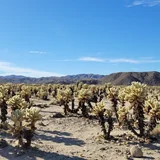
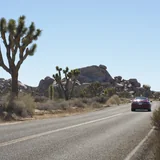
You can watch the handoff happen from the driver's seat. Come in through the west or north and you drive for miles through open forests of Joshua trees. Keep going south and east, down toward the Pinto Basin and the Cottonwood area, and the trees thin, shrink, and eventually vanish as the land drops and heats up. In their place, about 12 miles south of the north entrance, sits the Cholla Cactus Garden, a dense stand of teddybear cholla that marks the changeover ground between the two deserts. Around it you start to see ocotillo, which is not a cactus at all. Its tall spiny stems leaf out within days of rain and send up red-orange flowers in spring, and creosote, the low resinous shrub that dominates the desert flats. Our guide to the cholla garden and the southern park covers that drive and the hotter country beyond it, which is a good half-day if you want to feel the difference for yourself.
Those neighbors put the Joshua tree's slow life in perspective. Creosote spaces itself out across the flats by releasing chemicals from its roots that hold back other plants, and it can spread clonally into ever-widening rings that count among the oldest living things on Earth; the famous King Clone ring, out near Lucerne Valley beyond the park, is estimated at around 11,700 years old. The Joshua tree does not reach anything like those ages, but it is worth remembering that it is a creature of the Mojave in general, not of this one park. Wild stands grow across parts of California, Arizona, Utah, and Nevada. The park holds some of the best and most accessible groves, but the high desert around Yucca Valley, where the house sits, is squarely inside its natural range.
The best places to see them
If your main aim is to stand among big, healthy Joshua trees, point yourself at the Mojave half of the park. The busiest and most convenient way in is the West Entrance, at the town of Joshua Tree, five miles south of the junction of Highway 62 and Park Boulevard. From there the road runs straight into the thick of the Joshua tree forest, and the light is kindest in the first hour after sunrise and the last hour before sunset, when the low sun catches the branches and the crowds thin out.
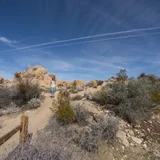
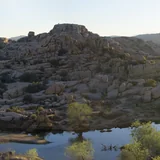
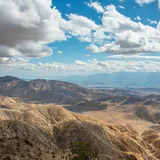
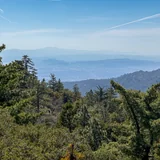
Several of the park's easiest and best-loved walks thread right through that forest. The Hidden Valley loop is an easy one-mile trip around a rock-ringed basin; the Barker Dam loop is a comparable easy walk of about 1.1 miles that also passes a historic water tank and a rock-art site; and the paved road up toward Keys View climbs through Joshua tree stands to a drive-up overlook near 5,185 feet, where on a clear day you look out over the Coachella Valley, the San Andreas Fault, and the Salton Sea. The short Cap Rock nature loop, an easy walk of about 0.4 mile named for the flat boulder perched on top of the formation, runs among trees and rock piles on the same loop road and makes a gentle stop between the bigger sights. Any of these puts you among the trees without a hard hike. Our roundup of the best hikes in Joshua Tree sorts them by effort so you can match a walk to your morning.
For the tallest and oldest specimens, the ones photographers make a special trip for, head up to the higher western edge of the park; our Covington Flats guide maps out where the biggest old trees stand and how to get there on the quieter back roads. And you do not have to enter the park at all to see them. The high desert around Yucca Valley sits at roughly 3,300 feet, well inside Joshua tree range, so wild trees line the drive in and dot the neighborhood around the house. The property is about a 25-minute drive from the West Entrance, close enough that you can spend a morning in the park groves and be back at the pool by early afternoon.
Fire and a warming climate
The Joshua tree looks permanent, the way anything that outlives us tends to. Its future is less settled than that. The plant is threatened chiefly by a warming climate and by fire, and the two problems feed each other.
On the climate side, the concern is straightforward and sobering. As the desert heats and dries, the conditions Joshua trees need in order to sprout and survive shift up in elevation and northward, and the seedlings that would replace the old trees struggle to get established. The grown trees can hang on for a long time, but a forest with no new young coming up behind it is a forest slowly aging out. Some climate models project that the species could be largely lost from Joshua Tree National Park itself within about a century. That is a projection, not a certainty, and the exact outcome depends on how the climate actually plays out and on how the park is managed, so it is worth reading current park science rather than treating any single number as fixed. The direction of the worry, though, is not in dispute.
Fire is the sharper, faster danger. Deserts did not historically carry big fires, because the plants grew too far apart to spread flame. As fires have grown more frequent, these slow-growing yuccas turn out to be poorly adapted to them. A pine forest can regenerate after a burn in decades; a Joshua tree that adds an inch or two a year cannot. A stand that burns may not come back within any timeframe that means much to a visitor, which is why this is high-desert country where wildfire is taken very seriously.
The two threats also compound each other. A hotter, drier climate stresses the trees and holds back the seedlings that would replace them, and a landscape that burns more often clears out the mature trees faster than new ones can grow up in their place. The upshot is not that the trees will vanish next year; they are long-lived, and many will stand through all of our lifetimes. The concern is longer-term and quieter, about whether the young trees now coming up will be able to carry the forest forward another century or two. Before you travel, it is smart to check the park's current alerts for any fire restrictions or closures, and to be careful with anything that could throw a spark during a dry, windy spell.
How to treat them
Everything about the way a Joshua tree lives, its slow growth, its single fussy pollinator, its trouble recovering from harm, adds up to a simple rule for visitors: leave them alone and let them be. The park service asks the same of everyone, and the guidelines are easy to follow.
- Take nothing. Collecting or removing rocks, plants, cactus, wood, or wildflowers from the park is prohibited; the standard national-park rule is to leave everything exactly as you found it, so future visitors and the desert itself get the same.
- Stay on the roads and trails. Vehicles must keep to established roads, and driving off-road is banned because it crushes desert soil and the young plants trying to grow in it. On foot, staying on the trail keeps boots off the seedlings that will one day be the next generation of big trees.
- Do not climb, carve, or hang on them. A Joshua tree is not built like a real tree, and damage to the trunk or branches does not heal on any human timescale.
- Keep dogs close and out of the backcountry. In the park, pets are not allowed on hiking trails and must stay within 100 feet of roads and campgrounds, always on a leash no longer than six feet.
None of this is complicated, and the reasoning behind it is the same reasoning that runs through this whole post: these plants grow back at the speed of inches per year, so a moment's carelessness can undo a century of growth. If you want the fuller picture of desert etiquette, our note on desert safety and leaving no trace gathers the practical habits worth bringing along.
Seeing them from the house
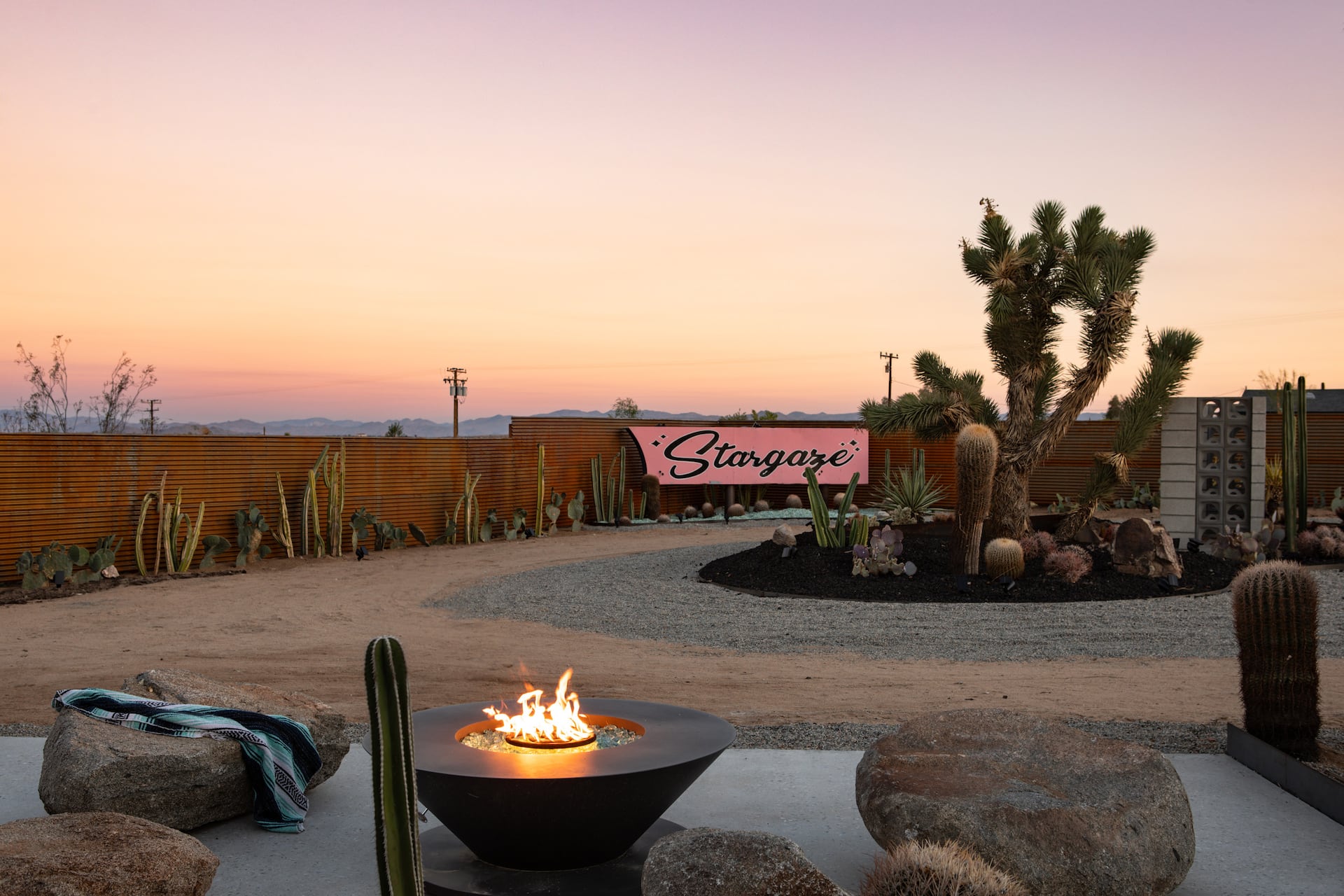
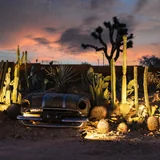
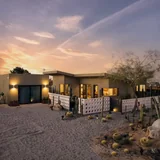
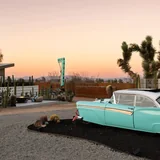
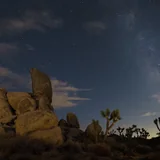
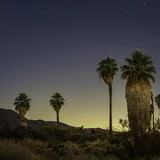
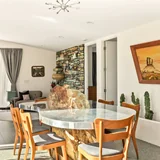
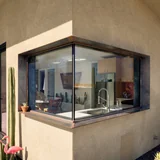
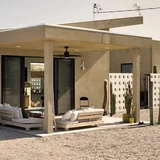
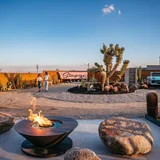
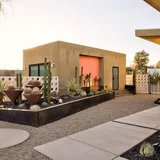
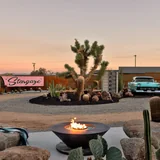
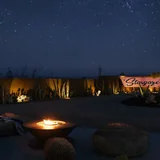
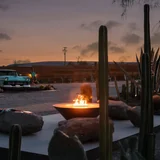
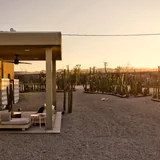
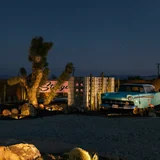
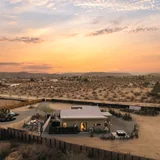
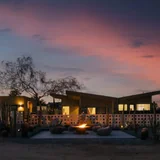
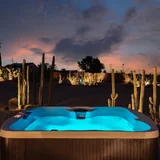
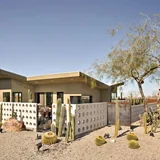
You do not have to wait for the park gate to meet a Joshua tree. Stargaze Escape sits on a fully fenced desert lot in Yucca Valley, up in the high Mojave at around 3,300 feet, landscaped with thousands of cacti, agave, and Joshua trees of its own. You can look at them from the stock-tank pool, from the hot tub that stays open all year, and from the restored 1950s car parked on the gravel with its custom stargazing roof pulled back, which makes a fine place to lie out under the stars once the sky goes dark.
One review of the house put the everyday experience of the place plainly:
"photo-worthy spots everywhere" — one review
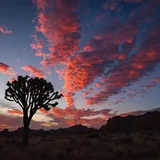
The trees on the lot are part of that. Morning light rakes across the branches, evening turns them gold and then violet, and the plants ask nothing of you except that you leave them where they are, the same courtesy the park asks and the same house rule that covers the cacti and rocks around the property. If you want to know more about what is growing around you, the piece on the cactus garden walks through the lot, and after a day in the park groves the pool and hot tub are the natural place to end up.
So here is a plan you can actually use. Check the park's current bloom and fire updates a few days before you travel, so you know whether the trees will be flowering and whether anything is closed. Then book your dates and set aside one early morning for the Joshua tree groves, whether that is the easy loops near the West Entrance or the big old trees up at Covington Flats. Bring more water than you think you need, since there is none inside the park, and fuel up in town before you go, because there are no gas stations in the park either. When you are ready, you can check availability and book your stay, and the trees will be waiting, growing their slow inch, exactly where they have always stood.