















Month by month
Joshua Tree in July
July is the hottest month of the year around Joshua Tree and one of the two quietest in the national park. Afternoon highs in Yucca Valley average in the mid 90s, Twentynine Palms passes 100°F on most July days, and the first monsoon thunderstorms of summer can send flash floods down washes that are normally dry. It is also the middle of Milky Way season. A July trip works if you plan each day around the heat and watch the weather.
July heat in numbers
NOAA's 1991 to 2020 climate normals for its Yucca Valley station, at about 3,250 feet, give July an average high of 96°F, an average low of 66°F and a daily mean of 81°F. The normal high edges up from about 95°F on July 1 to 97°F by July 31, and the warmest normal of the whole year, a little over 97°F, falls in the last week of the month. In an average July the station counts about 29 days at 90°F or above and about eight days at 100°F or above. On average, not one July night drops to 50°F.
Lower ground is hotter. NOAA's Twentynine Palms station, about 1,300 feet below Yucca Valley near the park's North Entrance, averages a July high of 104°F and a low of 77°F, and it reaches 100°F on about 28 of July's 31 days. The park's lower eastern and southern sections, including the Pinto Basin and Cottonwood, belong to the lower, hotter Colorado Desert. Park rangers say summer temperatures inside the park can hit 120°F.
Monsoon season begins
The National Weather Service in Las Vegas, whose forecast zone includes Yucca Valley and the rest of the Morongo Basin, describes the pattern this way: in the warm season, typically July and August, a push of monsoon moisture moves into the Mojave Desert, raising the humidity and setting off scattered thunderstorms. Their gusty winds sometimes cause damage, but the bigger threat is heavy rain, and the flash floods it triggers often sweep down normally dry washes.
The rain totals look small on paper. July's normal rainfall in Yucca Valley is 0.46 inch, the most of any summer month at that station, and the station averages only about one July day with a tenth of an inch or more. Twentynine Palms gets less in July (0.40 inch) and more in August (0.65 inch). Monsoon storms are local, so a station average says little about what a single cell can drop on one canyon.
The park says flash floods can happen at any time but are most common in late summer and early fall, that they are unpredictable and can be deadly, and that you can't outrun one. If water starts rising, head for higher ground immediately. The weather service adds the numbers: six inches of fast-moving water can knock over an adult, 12 inches of rushing water can carry away most cars, and more than half of flood drownings happen when someone drives into flood water. Turn around, don't drown. The park also notes that flooding may subside within hours, so patience is the safe choice.
Lightning comes with the same storms. The weather service's rule is "When thunder roars, go indoors," and it says there is no safe place outside when a thunderstorm is nearby. If you hear thunder on a summit, a ridge or a pile of boulders, go back to the car.
Planning a July day in the park
The park's own advice is to hike before 9 am and after 5 pm, and July is when it matters most. A good day starts at first light, which comes around 5:10 am early in the month and closer to 5:30 am by the end, on one of the short trails the park recommends for summer, such as Barker Dam, Hidden Valley or Cap Rock. By late morning, switch to what the park suggests for the hot hours: a driving tour on the paved roads with the air conditioning on, and the exhibits in the air-conditioned visitor centers.
Stay on pavement. The park warns that breaking down or getting stuck on a dirt road in summer can be deadly. Before you pull out of a parking space, look under the car, because animals may use it for shade, and make sure nothing is hanging beneath the vehicle and dragging on the pavement, like a tow chain. Bees look for water in summer, and the park names the Jumbo Rocks campground, Keys View and the Cholla Cactus Garden as places they gather. Cell coverage is patchy and the park has emergency phones in only three places, so tell someone your plan before you go. Our notes on desert safety and Leave No Trace go further.
Know when heat illness has become an emergency. In its summer guide the park lists the signs of heat illness as nausea, vomiting, headache, cramps, a weak and rapid pulse, a high body temperature, confusion, unconsciousness and seizures, and it warns that hiking in extreme heat can lead to hyponatremia and death. Anyone who is confused or collapsing in the heat needs 911. Move them into shade and cool them down while you wait.
The Fourth of July
Leave the fireworks at home. The park prohibits them, and the local radio station's 2026 holiday notice said fireworks are illegal in every part of the Morongo Basin, with CalFire enforcing zero tolerance and fines of up to $50,000. Inside the park, the summer fire restrictions (no campfires, open flames or charcoal fires) are in force, and the park says Covington Flats Road may close over the Fourth of July weekend to prevent human-caused wildfires in extreme fire conditions.
There are public shows instead. In 2026 Yucca Valley held its Independence Day concert and fireworks at the Yucca Valley High School stadium on July 3, with fireworks around 9 pm, co-sponsored by the town and the Twenty-Nine Palms Band of Mission Indians. On July 4, Twentynine Palms hosted a free celebration at Knott Sky Park, with fireworks launched from Tortoise Rock Casino at about 9 pm. Venues and dates change, so check the town and city announcements closer to the holiday.
Independence Day weekend was also a fee-free period in the park in 2026 (July 3 to 5); the list is redrawn each year, so check before counting on it. Looking ahead, the Naval Observatory's tables show a new moon on the evening of July 3, 2027, so the holiday weekend that year will have no moonlight once the fireworks are over.
Visitor numbers
If you want the park as empty as it ever gets, July and August are the months. The NPS counted 139,664 recreation visits in July 2025, the lowest of any month that year, compared with 411,993 in March. That is about 4,500 visits a day in July against roughly 13,300 a day in March. July 2024 was the low point of that year too, at 123,786. Going back to 2017, and leaving out 2020 when the park closed for part of the spring, the least visited month of every year was either July or August.
Milky Way season
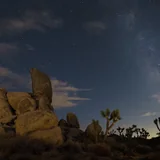
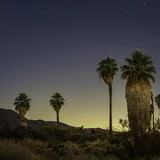
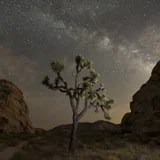
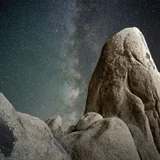
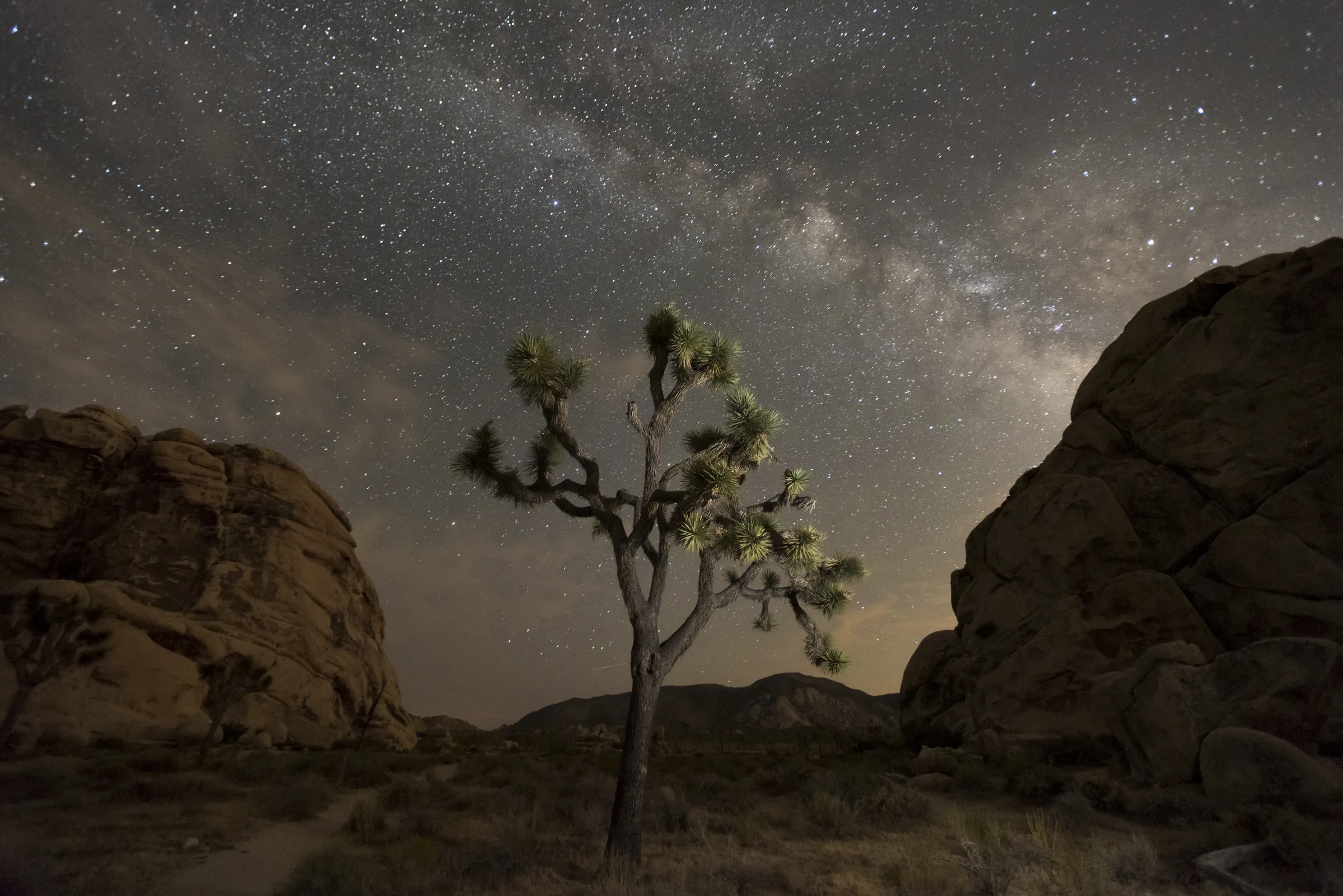
July is prime Milky Way season. The bright core of the galaxy stands in the south, in the constellations Scorpius (look for red Antares) and Sagittarius, whose teapot-shaped group of stars points toward the galactic center, and in summer it rides high in the south in the late evening. Straight overhead, look for the Summer Triangle (Vega, Deneb and Altair).
The nights are short but getting longer. The Naval Observatory's 2026 tables for Yucca Valley have the sun rising about 5:38 am and setting about 8:01 pm on July 1, roughly 14 hours and 23 minutes of daylight, and rising about 5:56 am and setting about 7:47 pm by July 31, about 13 hours and 51 minutes. Full darkness begins around 9:45 pm on July 1 and about 9:23 pm by the end of the month, and lasts until roughly 3:54 am and 4:20 am.
Two modest meteor showers peak together at the end of the month. On the American Meteor Society's calendar, the alpha Capricornids are active from about July 3 to August 15 and the Southern delta Aquariids from about July 12 to August 23, and both peak around July 30 to 31. The Capricornids rarely produce more than five meteors an hour, but they are known for bright fireballs. The delta Aquariids are mostly faint and show best from the southern tropics. In 2027 the peak comes just before the August 2 new moon, so the sky stays dark until a thin waning crescent rises in the small hours (about 2:30 am on July 30, by the Naval Observatory's Yucca Valley tables), and the society expects generally favorable moon conditions. The Perseids also begin in July, on about the 17th, though their big night comes in August.
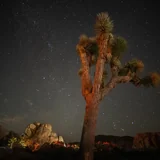
For the darkest skies, the park's summer guide points to Pinto Basin Road, which has the least traffic, along with pullouts and spots such as Quail Springs and Hidden Valley. Our guide to where to stargaze has more, and stargazing at the house covers the view from home.
Packing for July
Dress for the sun as much as the heat. Loose, long-sleeved layers and a hat, plus sunglasses and sunscreen, are what the park advises for summer. Also bring:
- Four liters of water per person for any day in the park, plus more for soaking a hat or bandana.
- Electrolytes. Water alone isn't enough on a long hot day; the park lists hyponatremia among the risks of hiking in heat.
- A rain shell or poncho for monsoon afternoons, and a plan to wait out storms in the car or indoors.
- Sturdy closed shoes for trails and for walking around after dark.
- A red headlamp and a blanket or pad for lying out under the Milky Way.
- A sunshade for the windshield. Never leave people or pets in a parked car.
July at the house
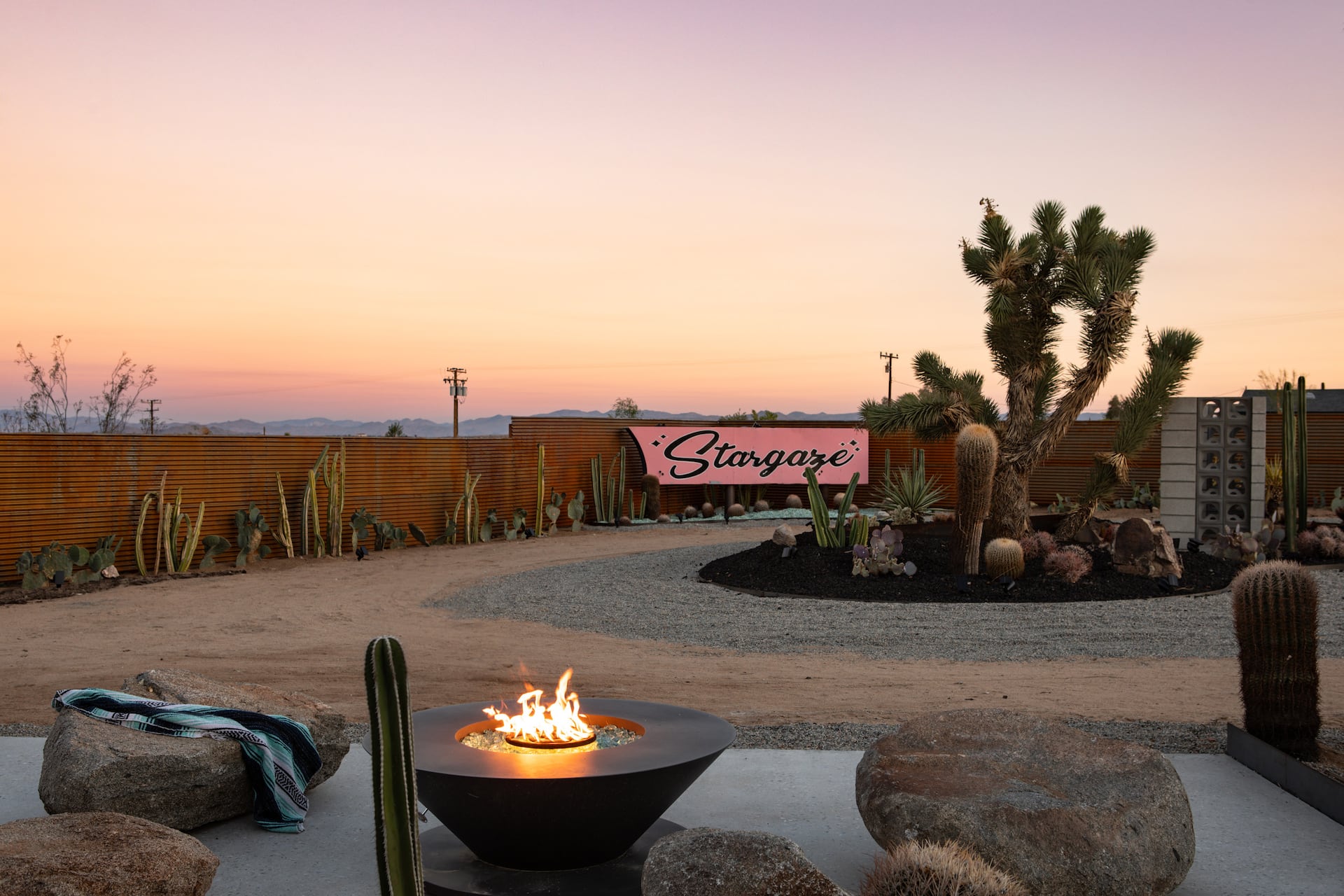
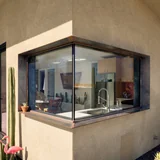
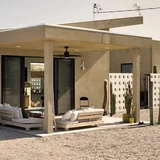
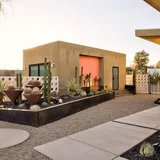
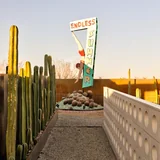
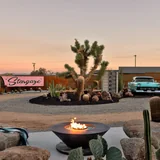
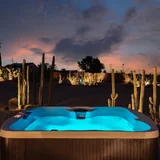
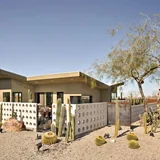
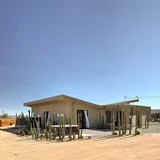
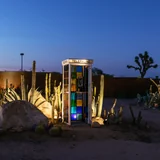
The house suits a July rhythm. It has air conditioning, so the bedrooms stay cool through the hottest part of the day, and the stock-tank pool, with its painted "Endless Summer" sign, is there for an afternoon swim. After dark, with normal lows in the mid 60s, the private hot tub is open as it is all year, and the car bed, with its custom stargazing roof, is a place to look up at the summer sky without leaving the fenced lot. Quiet hours start at 10 pm, which suits a night of stargazing. Keep glass away from the pool and hot tub. See the pool and hot tub page for photos and details.
Quick facts for July
- Normals. Yucca Valley: 96°F high, 66°F low, 0.46 inch of rain. Twentynine Palms: 104°F high, 77°F low.
- Storms. Monsoon thunderstorms are possible, and flash floods are most common in late summer and early fall. Never drive or walk into moving water.
- Closures. Fortynine Palms trail closed through September 30; several campgrounds partly closed for summer; park fire restrictions through October 1. Check the park's alerts.
- The holiday. Fireworks are illegal across the Morongo Basin, and Covington Flats Road may close over the Fourth of July weekend.
- Fees. The vehicle pass is around $30 for seven days; check the current fee and that year's fee-free days.
- Help. Call 911, and don't count on cell service in the park.
If a July trip sounds right, check dates for the house. Too hot to hike every day? Our rainy, windy and hot day ideas help fill the afternoons. For the months either side, read Joshua Tree in June and Joshua Tree in August.
Keep exploring
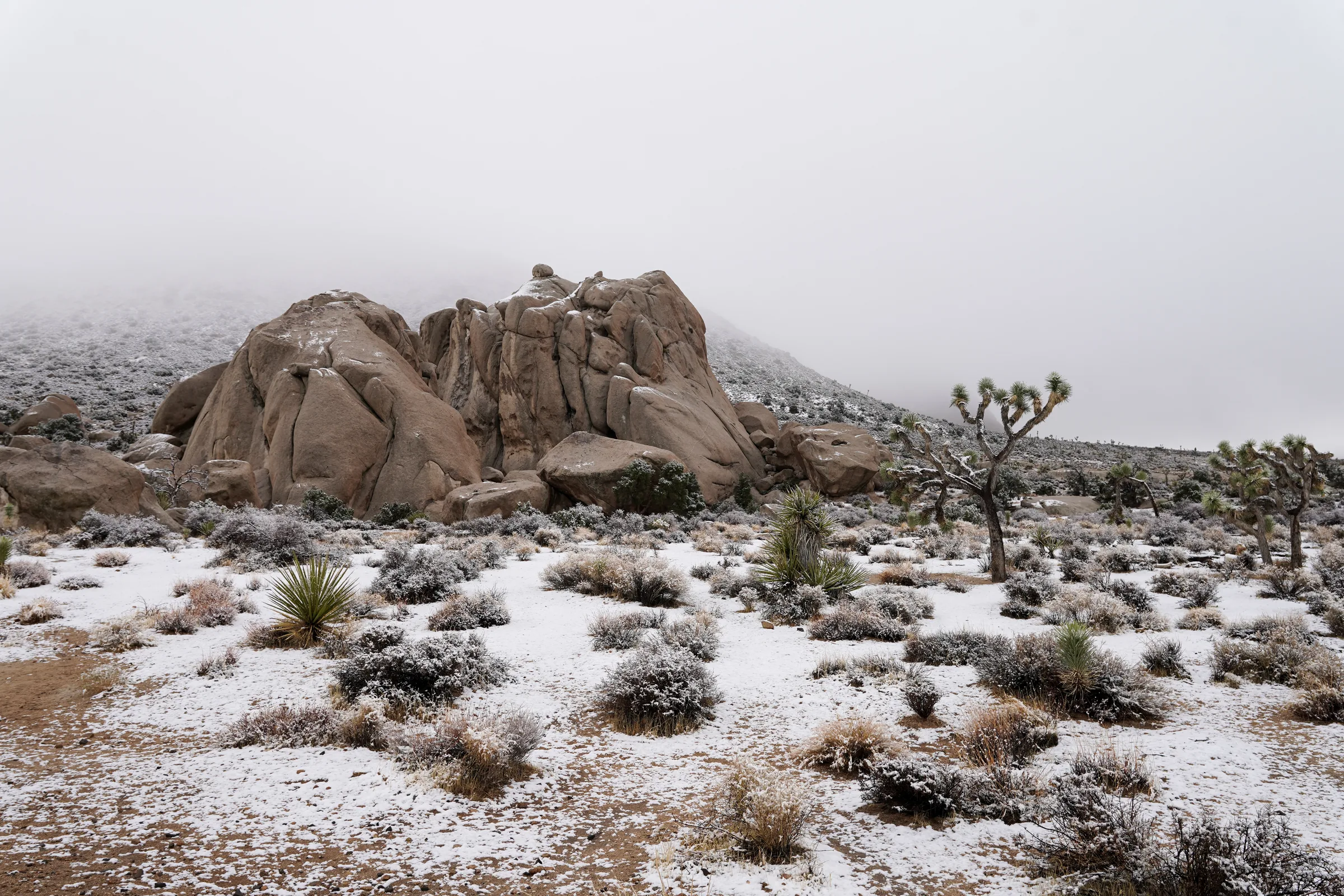
Joshua Tree in January
Joshua Tree in January: NOAA weather normals for Yucca Valley, short days, snow and road closures, crowd numbers, the Quadrantids and Palm Springs events.
Read →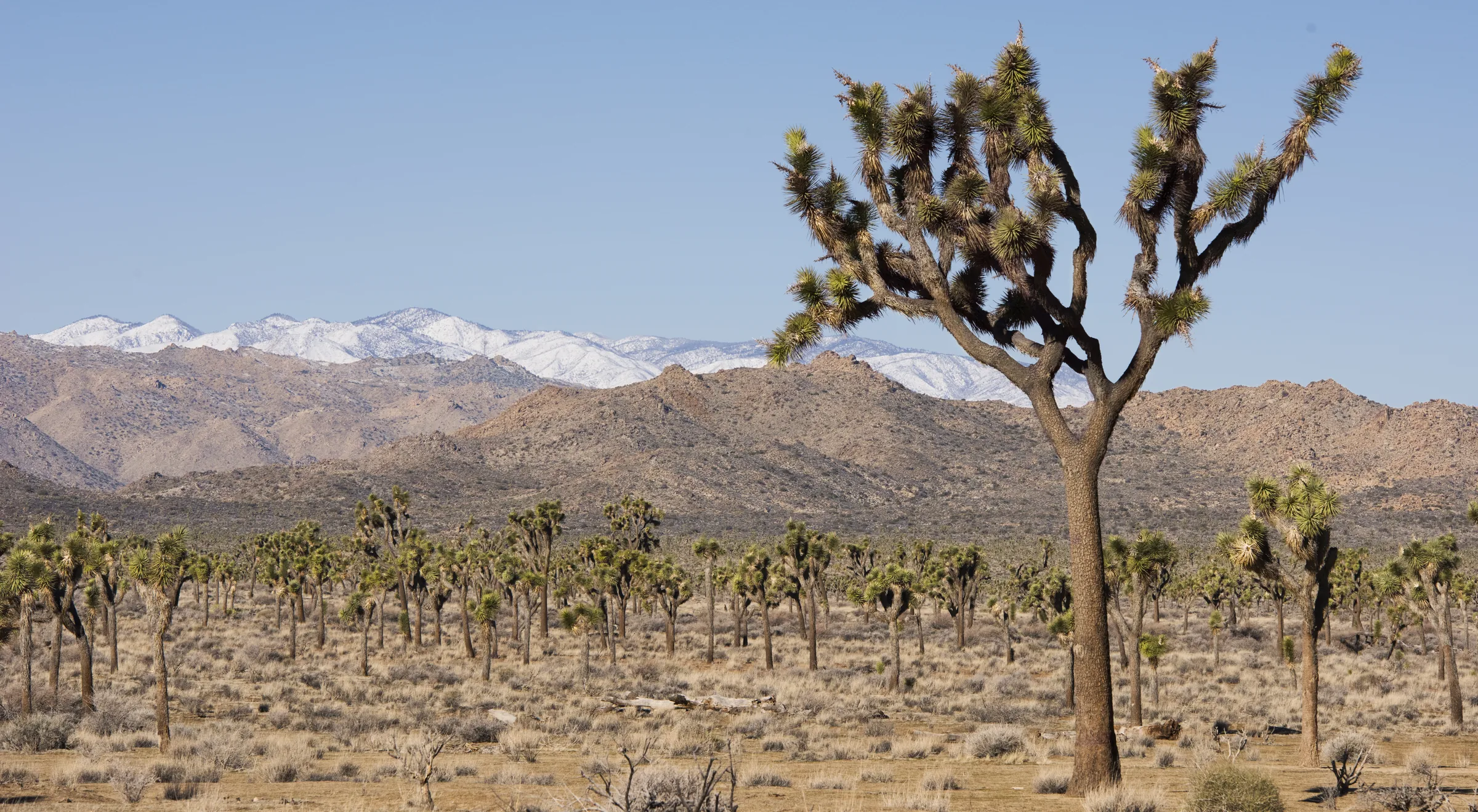
Joshua Tree in February
Joshua Tree in February: Yucca Valley weather normals, longer days, the start of spring crowds, Joshua tree blooms, Modernism Week and Mars and Jupiter in 2027.
Read →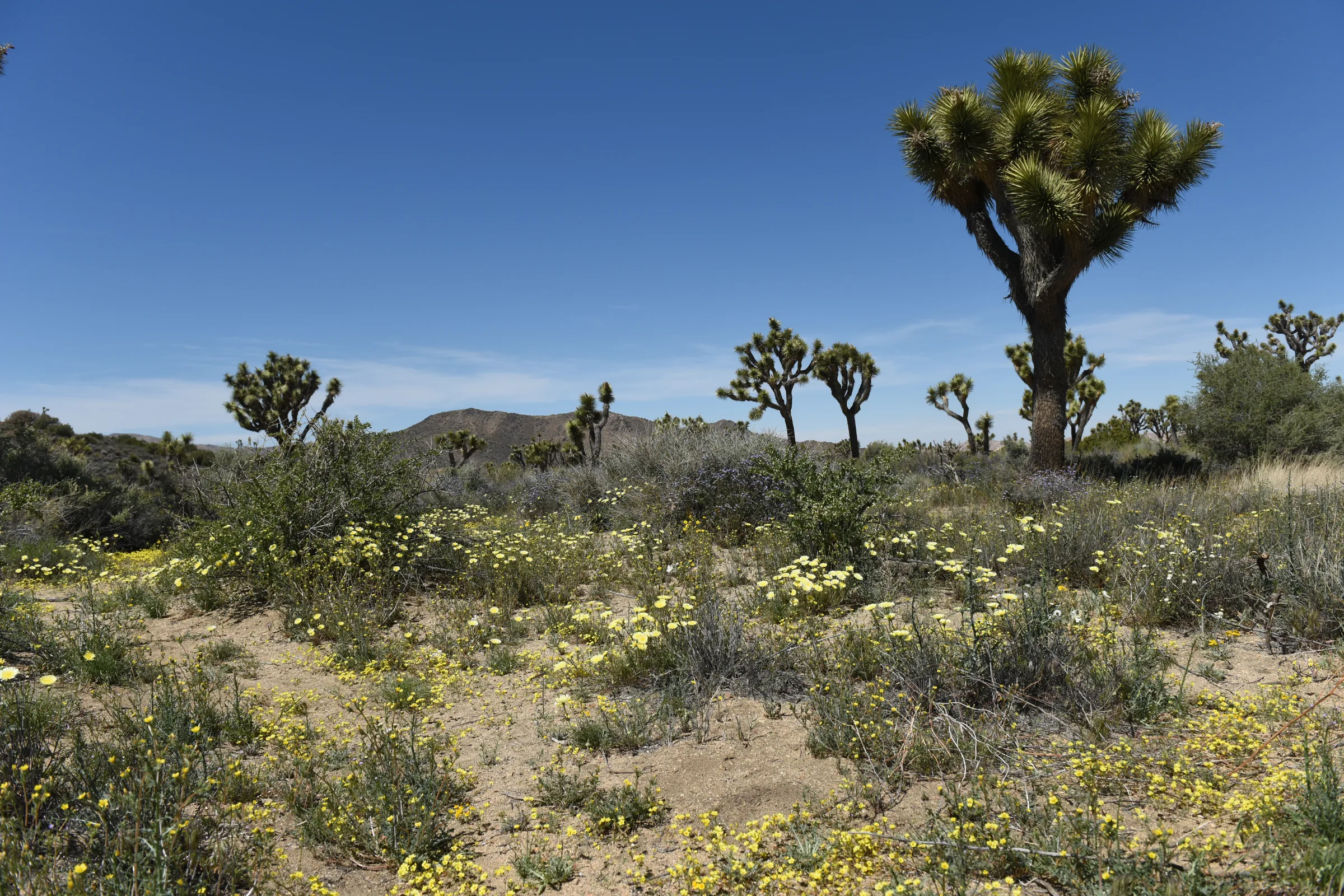
Joshua Tree in March
Joshua Tree in March: the park's busiest month, NOAA weather normals, the clock change, mid-elevation wildflowers, spring wind, the night sky and local events.
Read →