














Month by month
Joshua Tree in June
June is when Joshua Tree switches to summer rules. On June 1 the park closes the Fortynine Palms trail and parts of several campgrounds, the average high around Yucca Valley passes 90°F by the middle of the month, and the days are the longest of the year. Visitor numbers fall by about a third from May. Here is how June works, from the closures to the hours when hiking still makes sense.
How hot June gets
NOAA's 1991 to 2020 normals for its Yucca Valley station, at about 3,250 feet, give June an average high of 91°F and an average low of 59°F. This is the month the summer heat settles in. The normal high climbs from about 87°F on June 1 to 91°F at mid month and about 94.5°F by June 30. An average June brings about 22 days of 90°F or above and about five days of 100°F or above, and only about one night cool enough to reach 50°F.
June is also the driest month in the normals. Both Yucca Valley and Twentynine Palms list 0.00 inches of normal June rainfall, and neither station averages even one June day with a tenth of an inch of rain. Twentynine Palms, about 1,300 feet lower and close to the park's North Entrance, is much hotter: its June normals are 99°F for the high and 71°F for the low, with about 18 days of 100°F or more. The park service warns that summer temperatures in the park can reach 120°F, and that the interior has no water and no shade.
The National Weather Service renamed its top heat alerts in March 2025. What used to be an Excessive Heat Warning is now called an Extreme Heat Warning. The Morongo Basin is covered by the weather service's Las Vegas office. If a warning is posted for your dates, treat it as a day for the pool and the air conditioning.
The longest days of the year
The Naval Observatory's 2026 figures for Yucca Valley show the sun rising on June 1 about 5:35 am and setting about 7:52 pm, for roughly 14 hours and 17 minutes of daylight. At the solstice on June 21 sunrise is still around 5:35 am and sunset has moved to about 8:01 pm, giving the longest day of the year at roughly 14 hours and 26 minutes. By June 30 sunrise has slipped to about 5:38 am while sunset holds near 8:01 pm. Civil twilight, the first light good enough to walk by, starts about half an hour before sunrise, a little after 5 am all month.
The flip side is the shortest nights of the year. Around the solstice, full astronomical darkness lasts only from about 9:46 pm to about 3:50 am, roughly six hours. For stargazers that is a narrow window, and the air is still warm when it opens.
What changes in the park on June 1
The biggest change is at Fortynine Palms Oasis. The park now closes the trail every year from June 1 through September 30, saying heat-related incidents are common there because of its demanding terrain and lack of shade. Our Fortynine Palms Oasis guide covers it for the cooler months.
Camping shrinks too. On the park's current summer closures page, Belle and White Tank campgrounds close completely, and sites 40 to 101 at Indian Cove, sites 21 to 87 at Black Rock and Loop B at Cottonwood close from June 1 into late August, which the park says is due to low demand. Five backcountry zones (Eagle Mountain, East, Hexie Mountain, Pinto Mountain and Pleasant Valley) close from June 1 to September 1. The Indian Cove Ranger Station shuts for the summer, and the Black Rock Nature Center moves to a shorter schedule, listed as Thursday to Sunday, 9 am to 4 pm. Exact dates and site numbers are set each year, so check the park's alerts and our camping guide before you reserve.
Fire restrictions follow on June 15 and run to October 1. Across the whole park, campfires and open flames are banned, as are charcoal fires, barbecues and grills (self-contained gas stoves and grills are allowed), and you can't smoke within 10 feet of vegetation. The park cites high wildfire risk in summer, and fire is a particular threat to its slow-growing Joshua trees, which are poorly adapted to it.
Hiking on a summer schedule
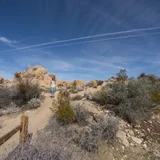
The park's summer advice is short: hike in the morning before 9 am and in the evening after 5 pm, and expect even a short hike to feel hard in the heat. It names trails longer than two miles to avoid in summer, including Boy Scout, Fortynine Palms, Lost Palms Oasis, Ryan Mountain, the Panorama Loop and Warren Peak. The short walks it suggests instead are the Bajada Nature Trail, Barker Dam, the Cholla Cactus Garden, Hidden Valley, Keys View, Cap Rock and the Oasis of Mara.
The warning has numbers behind it. In June 2024 the park's search and rescue team responded to four heat illness cases, all between 10 am and 5 pm, and two of them were on trails longer than two miles. That same month park staff talked with nearly 2,500 visitors, and about 300 of those conversations dealt with serious safety concerns.
For water, the park's summer guide says to carry four liters per person, plus extra for cooling off. It lists bottle filling stations at the Black Rock Nature Center, the West Entrance Station and the Joshua Tree Visitor Center on Park Boulevard in Joshua Tree. Learn the early signs of heat illness the park describes (irritability, a pale or flushed face, nausea, headache, cramps, a weak and rapid pulse). If they show up, get into shade, drink something with electrolytes and cool down.
The animals keep the same hours you should. Coyotes are generally most active at dawn, at dusk and through the night, especially in hot weather, and sidewinders, a common rattlesnake on the park's sandy flats, move about mainly in the evening and after dark during the warm season. The park's summer guide asks hikers to stay on the trail, watch where they step, and keep hands and feet out of nooks and cracks in vegetation and rocks. Carry a light for the walk back to the car at dusk.
Thinner crowds
June is when the park empties out. The NPS counted 155,366 recreation visits in June 2025, down from 230,328 in May, a drop of about a third, or roughly 5,200 visits a day. 2024 showed the same step down, from about 260,000 in May to about 172,000 in June. For comparison, March 2025 brought in nearly 412,000.
If crowds are what you want to avoid, June delivers that, at the price of the heat. Holiday dates still matter. In 2026 the park listed Flag Day, June 14, as an entrance-fee-free day. The list and its eligibility rules change every year, so check the park's fees page before you count on one.
June nights
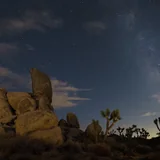
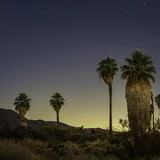
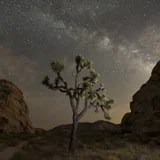
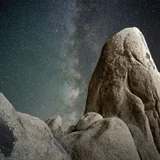
June opens the best stretch of the year for the Milky Way. In summer the bright core of the galaxy sits in the southern sky in Scorpius, marked by red Antares, and Sagittarius, whose stars form the "Teapot" that points toward the center of the galaxy. Overhead, the Summer Triangle of Vega, Deneb and Altair takes over. With full darkness arriving only around 9:45 pm, this is a late-night activity, and a planner app such as Stellarium or PhotoPills will show where the core sits on a given night.
The American Meteor Society's calendar has no major shower peaking in June; the next ones peak at the end of July. The moon matters more. The U.S. Naval Observatory lists a new moon on June 4, 2027 and a full moon on June 18, 2027, and in 2026 the new moon fell on the evening of June 14, Pacific time. The nights around a new moon are the darkest of the month.
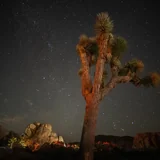
The park's summer guide names Quail Springs, Hidden Valley, Echo T, Ryan Mountain and roadside pullouts as places to look up, and singles out Pinto Basin Road as the road with the least traffic and the darkest skies. Give your eyes 20 to 30 minutes to adjust, and use a red light so you don't undo it.
Cooler places for the middle of the day
When a June afternoon is too hot for the desert, go up. The Palm Springs Aerial Tramway rides from the Valley Station at 2,643 feet to the Mountain Station at 8,516 feet in about ten minutes, and the tramway says the top is typically 30 to 40 degrees cooler than the valley floor. The Valley Station is about 50 minutes from the house. Our tramway guide covers tickets and the trails at the top. The mountain town of Idyllwild, in the San Jacinto Mountains, is another way to spend a hot day at altitude; see the Idyllwild day trip.
Indoors, the Palm Springs International ShortFest, a festival of short films, ran June 23 to 29 in 2026, its 32nd edition, with screenings in Palm Springs theaters. Its dates move each year. Each of the park's visitor centers also has a small exhibit area where, the park says, you can cool off.
What to bring in June
The park's summer packing advice covers the sun: sunglasses, long sleeves, loose-fitting clothing, a hat and sunscreen, because the UV is high. Beyond that:
- More water than seems sensible. Four liters per person for a day in the park, plus extra to soak a hat or bandana.
- Electrolytes. Drink mixes or salty snacks replace what you sweat out.
- A cooler in the car. There are no stores, restaurants or gas stations inside the park, so fill up in town first.
- A thin layer for late nights. Normal lows near 59°F can feel cool after a hot day.
- Downloaded maps. Cell coverage in the park is limited.
June at the house
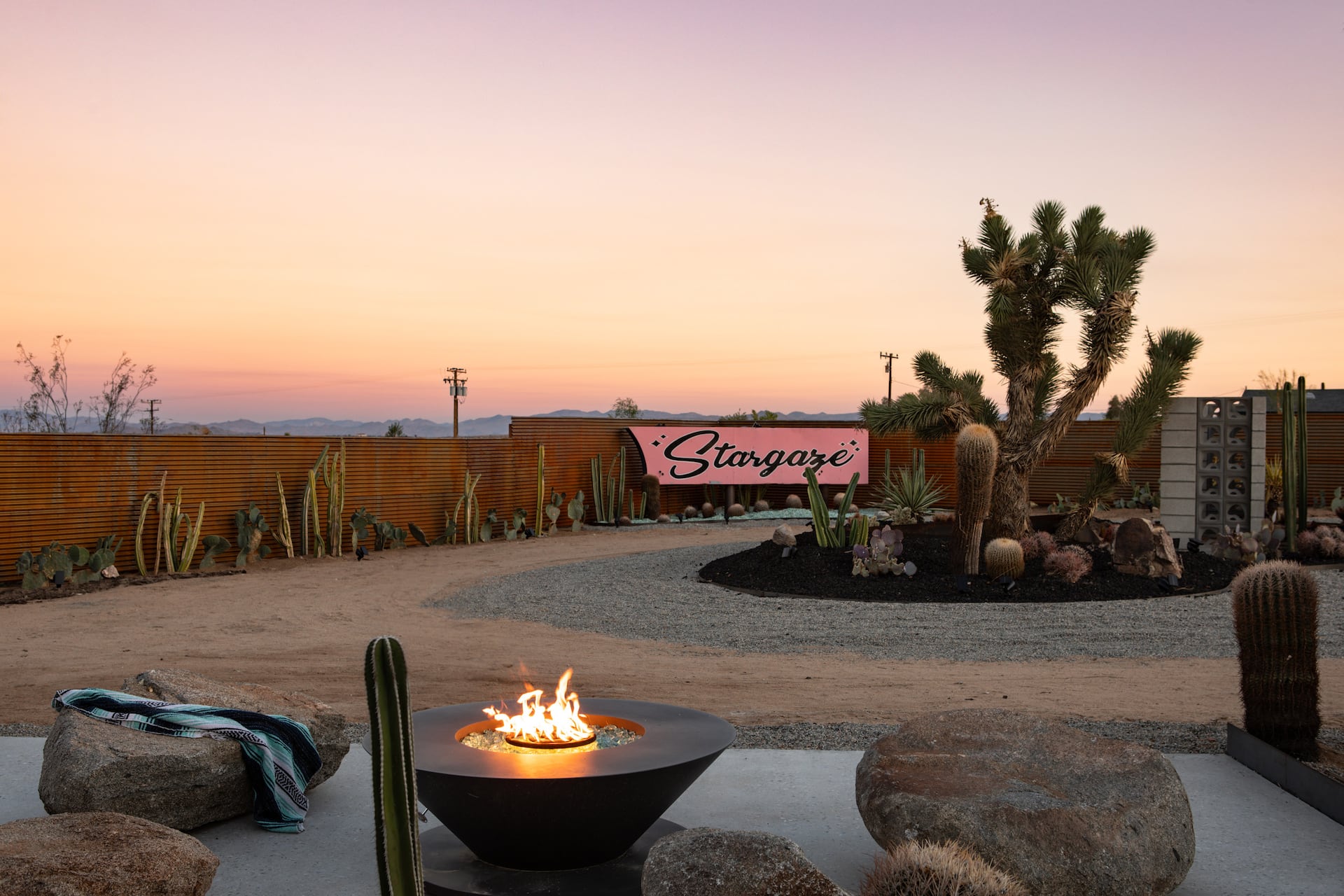
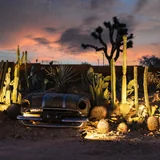
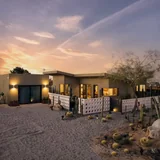
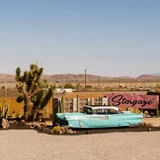
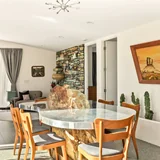
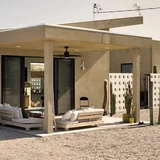
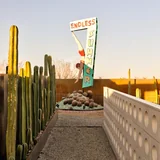
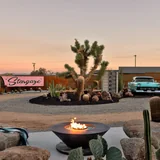
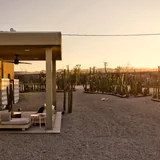
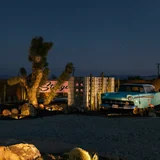
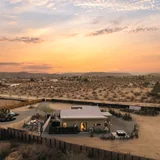
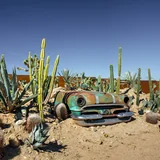
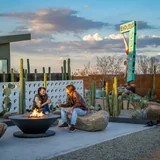
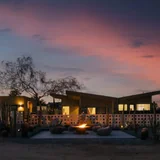
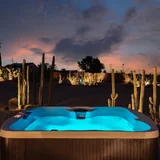
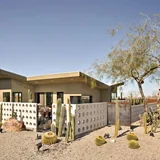
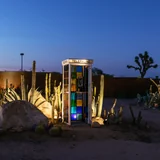
In June the house works on the same split schedule as the park. Mornings are for the trail. The hottest hours are for the stock-tank pool, inside its star-perforated steel privacy screen, and for the air-conditioned rooms inside. After dark, with normal lows near 59°F, the private hot tub is open as it is all year, and the car bed (the restored 1950s car on the gravel) is a place to look for the Milky Way, as long as voices stay low once quiet hours start at 10 pm.
If your dog is coming, the house welcomes dogs (cats aren't allowed because of an allergy), but the park's summer guidance is not to bring pets in summer and never to leave one in a car or tied up. Dogs aren't allowed on park trails in any season, so plan park outings that don't depend on bringing them. Our pet-friendly page has the house details.
June checklist
- Closures. Fortynine Palms closed June 1 to September 30; Belle and White Tank campgrounds and parts of others closed for the summer. Confirm on the park's alerts page.
- Fire rules. From June 15 to October 1, no campfires, open flames or charcoal fires anywhere in the park.
- Hiking hours. Before 9 am and after 5 pm, and skip trails over two miles.
- Heat alerts. Check the National Weather Service Las Vegas forecast for the Morongo Basin before you head out.
- Fees. The park's vehicle pass is about $30 for seven days. Fee-free days differ from year to year, so check the fees page.
- Emergencies. Call 911. The park lists emergency phones at the Cottonwood Visitor Center, the Indian Cove Ranger Station and Intersection Rock, and cell service is unreliable.
Ready to plan? Check dates for the house. For the month before, see Joshua Tree in May, and for the hottest month and the start of the monsoon, read Joshua Tree in July.
Keep exploring
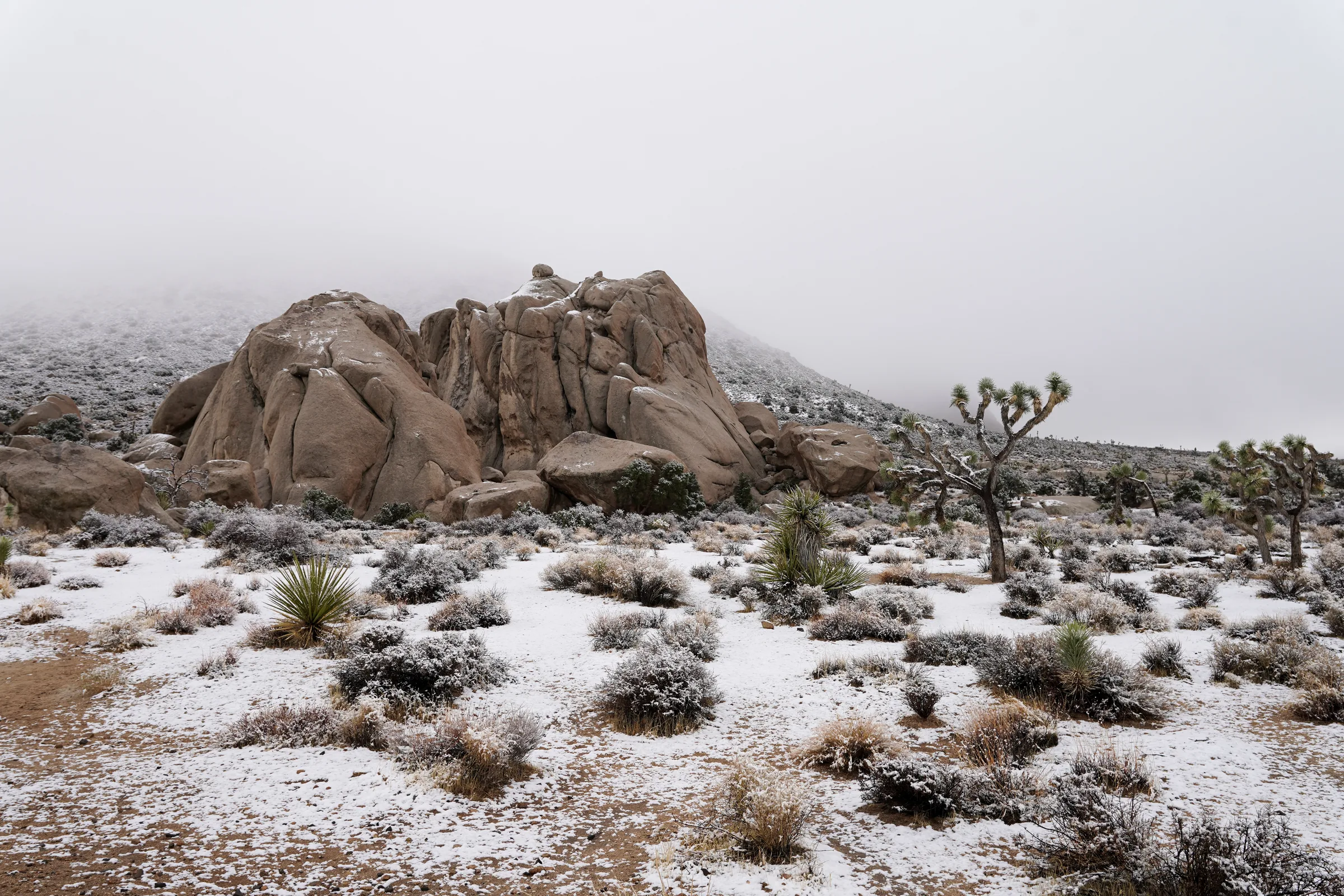
Joshua Tree in January
Joshua Tree in January: NOAA weather normals for Yucca Valley, short days, snow and road closures, crowd numbers, the Quadrantids and Palm Springs events.
Read →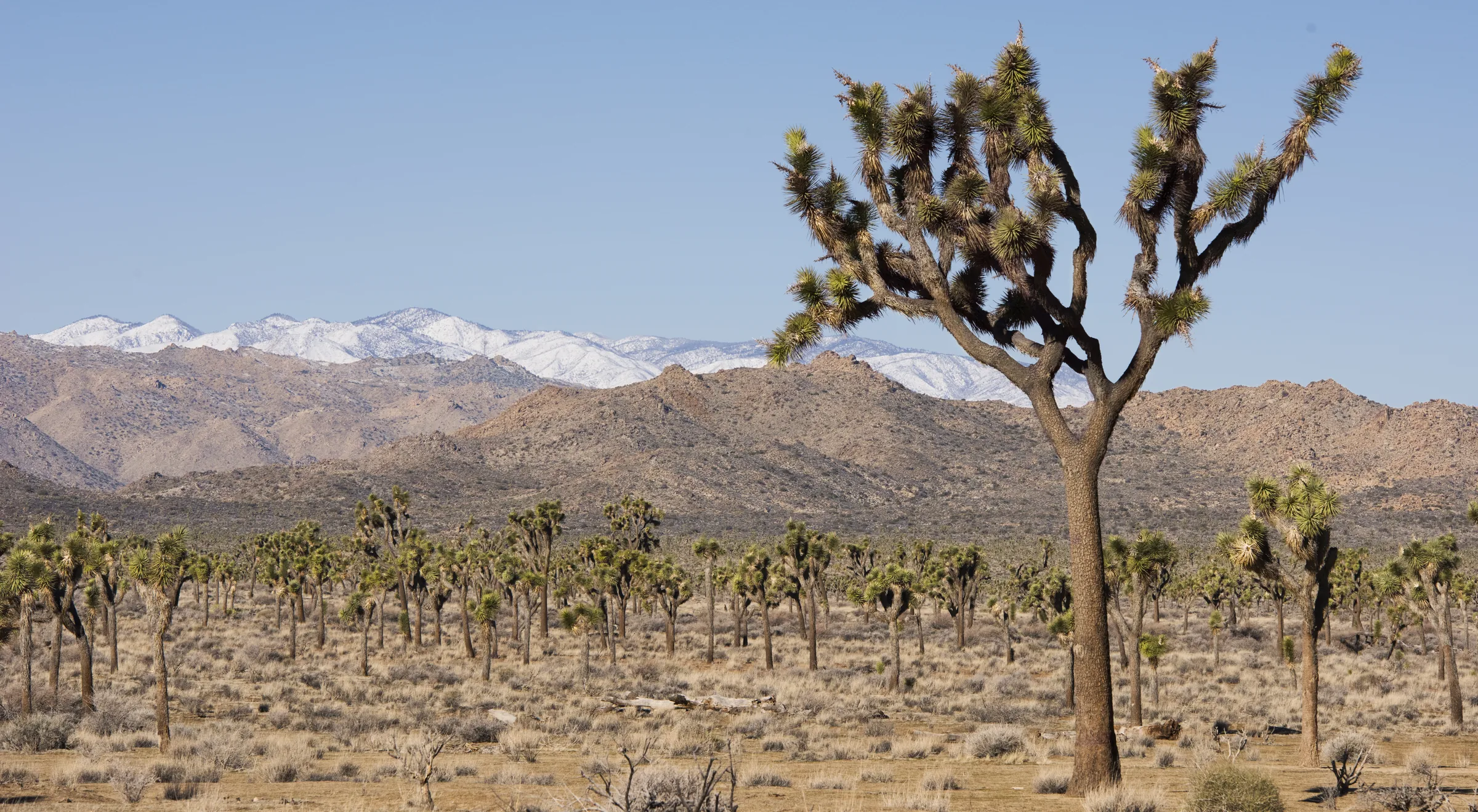
Joshua Tree in February
Joshua Tree in February: Yucca Valley weather normals, longer days, the start of spring crowds, Joshua tree blooms, Modernism Week and Mars and Jupiter in 2027.
Read →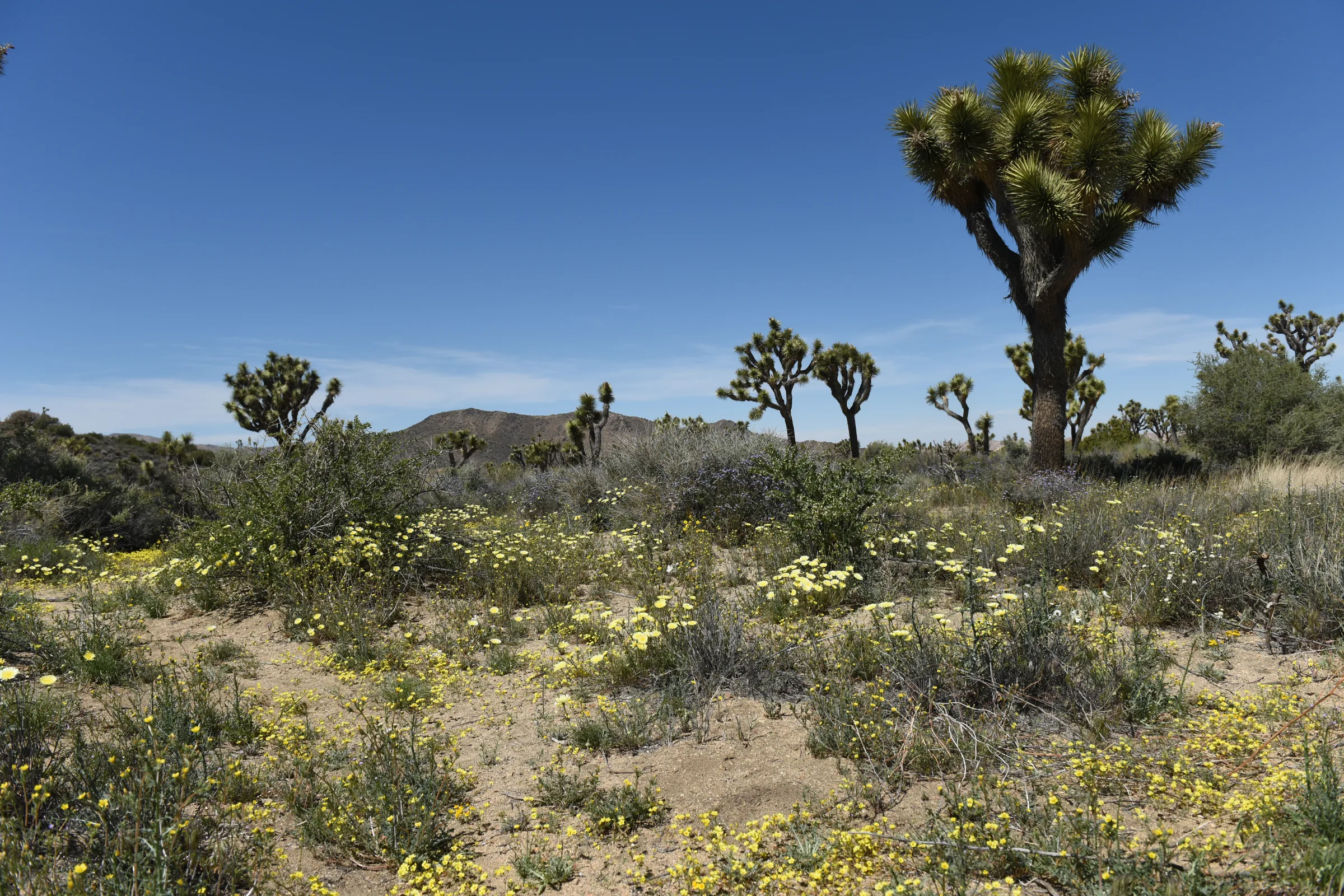
Joshua Tree in March
Joshua Tree in March: the park's busiest month, NOAA weather normals, the clock change, mid-elevation wildflowers, spring wind, the night sky and local events.
Read →