










Practical
Accessible Joshua Tree
Joshua Tree is one of the more welcoming national parks to enjoy from a car, and much of what draws people here — the stacked boulders, the Joshua trees, the long desert views — sits within sight of the paved roads. Most of its trails, though, are natural dirt and sand, so a comfortable visit for someone with limited mobility rewards a little planning ahead. This guide covers the paved and boardwalk trails, the drive-up viewpoints, the accessible restrooms and visitor centers, and how to shape an unhurried day, with Stargaze Escape about 25 minutes from the park's west entrance as your home base.
What to Expect from the Trails
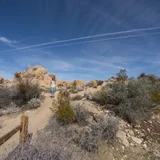
It helps to start with an honest picture of the ground. Most trails inside Joshua Tree National Park are natural surfaces — packed dirt, loose sand, and rock — rather than pavement. That is part of what keeps the park feeling wild, and it also means the classic hikes you read about, from the boulder loops to the palm-oasis routes, generally are not built for wheels or for anyone who needs a firm, level path underfoot.
The better news is that the park still gives you a great deal without a long walk. One trail, the Oasis of Mara, is fully paved and suitable for all wheelchairs. A short paved path at the Keys View overlook is the other reliably accessible spot. A couple of others — Cap Rock and the Bajada Nature Trail — are hard-packed with some boardwalk, and they work for some visitors and not others, depending on how loose the sand is that week and how you get around. Beyond those, the scenery does most of the work from the road, and there is a lot of it.
It also helps to know the lay of the land, because the park takes in two deserts and the accessible highlights are spread across both. The higher, cooler Mojave Desert fills the west and north — this is the half with the Joshua trees, the big boulder piles, and the Keys View overlook, and it is the closest to the house. The lower, hotter Colorado Desert lies to the south, down toward the Cottonwood entrance, with its ocotillo, creosote, and the Cholla Cactus Garden. Most visitors basing near Yucca Valley concentrate on the Mojave half by the west and north entrances, which is where the paved Oasis of Mara loop and the roadside boulders sit.
So the plan for many visitors with limited mobility leans less on hiking and more on driving the scenic roads, stopping at the paved viewpoints, and taking the couple of short accessible walks at an easy pace. There is no shame in seeing a national park mostly from the seat of a car; Joshua Tree happens to be well suited to it, because the boulders and the trees crowd right up to the pavement in the busiest stretches. If you want to see how this compares with the longer routes most first-timers tackle, our guide to the best hikes in Joshua Tree lays those out, and our post on what to know before you visit covers the wider logistics. Park facilities and trail conditions do change over time, so it is worth confirming the current details with the National Park Service before you set out.
The Paved and Boardwalk Trails
Four short walks are worth knowing by name, because they are the ones the park itself flags for accessibility. They range from a smooth paved loop that any wheelchair can manage to a couple of sandier paths that suit some people and not others.
The standout is the Oasis of Mara. It is a paved loop of about half a mile with minimal elevation change, set at park headquarters in the town of Twentynine Palms, by the park's north entrance. Benches are placed along the way, interpretive panels explain the springs and the palms, and the park lists it as suitable for all wheelchairs. Part of the trail has been closed after flood damage, so check the park's alerts before you go. If you only manage one walk inside the park, this is the one that asks the least of you and gives back a real desert oasis in return. Our Oasis of Mara guide goes deeper into its history and what you will see along the loop.
At the far southwest of the scenic road, Keys View has a short paved lower viewpoint path of about a tenth of a mile, with tactile maps and geology exhibits set at the overlook. It is the wheelchair-suitable option up at that famous vista, and because the parking is right there, you can take in the view with very little distance to cover.
Two more are worth a mention with a caveat. Cap Rock is a loop of about four-tenths of a mile on hard-packed sand rather than pavement, roughly 36 inches wide, with about 20 feet of elevation change; the sand can be loose in places, so it suits some wheelchairs and not all. The Bajada Nature Trail, near the south end of the park, is about a quarter mile on hard-packed sand with boardwalk sections; a narrow boardwalk and level changes of up to an inch mean it may not suit every wheelchair, though it is a gentle way to read the Colorado Desert plant life close up. Because conditions on these sand-and-boardwalk paths shift with weather and maintenance, check the park's current accessibility notes before you count on either one.
Drive-Up Viewpoints
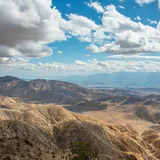
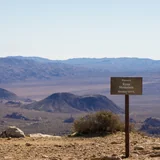
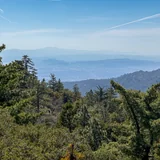
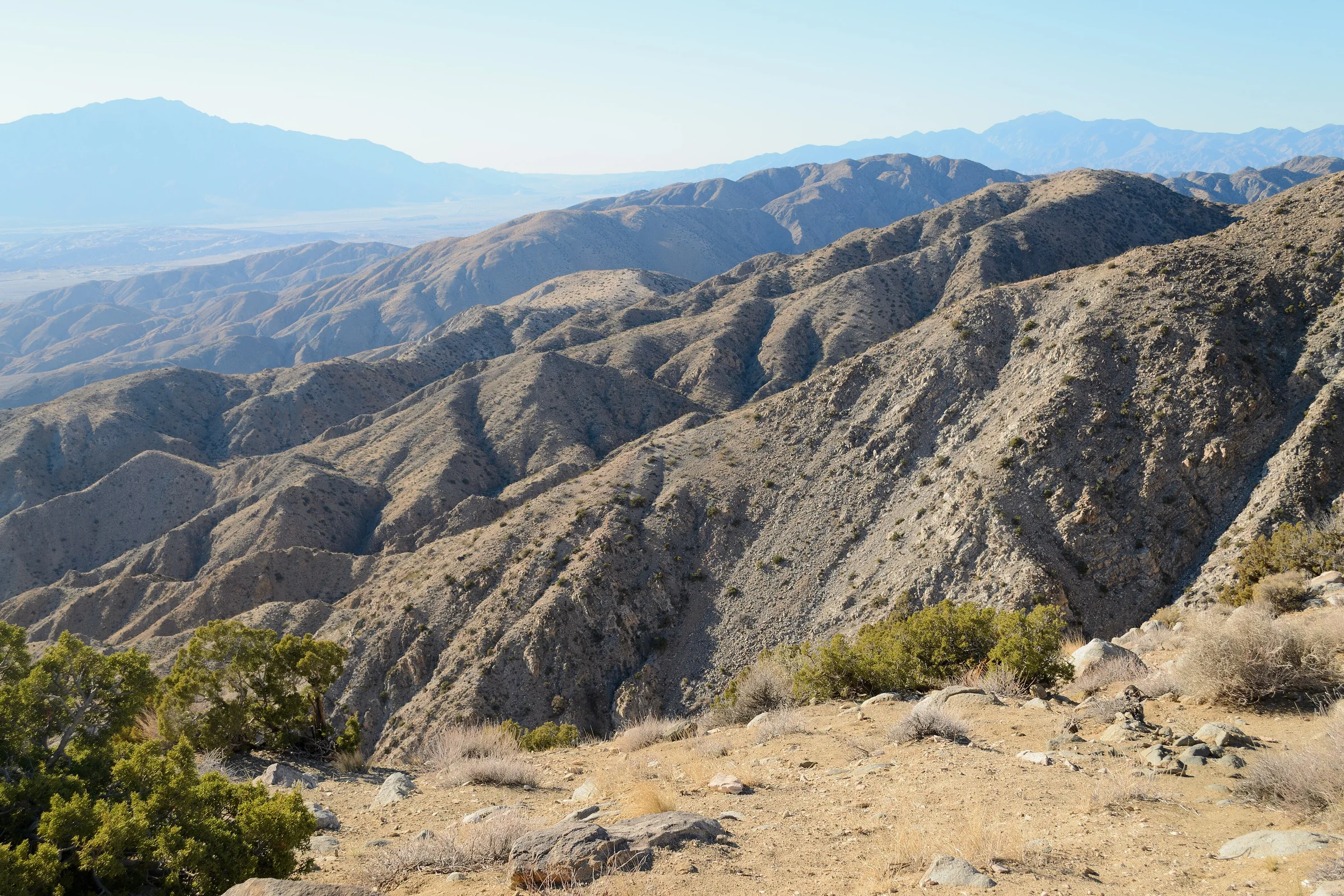
The single best payoff for the least effort is Keys View. It is a drive-up overlook sitting at roughly 5,185 feet, reached on a paved road that ends at a paved parking area, with a short paved loop of about a quarter mile at the top. On a clear day the view runs out over the Coachella Valley, the line of the San Andreas Fault, the Salton Sea in the distance, and the high peaks of San Jacinto and San Gorgonio. You can see much of it from close to the car, and the accessible lower path with its tactile maps lets you stay a while without a hard walk. The turnoff branches south from the main park road and climbs gently on pavement the whole way, so the elevation gain is the car's work and not yours. Mornings tend to be clearest; afternoon haze can soften the far view, so time it early if the long sightlines matter to you.
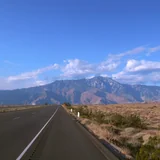
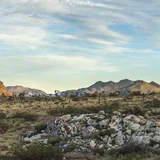
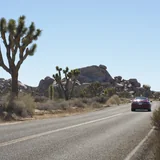
What makes Joshua Tree unusual is that Keys View is only the headline. A great deal of the park's scenery is right beside the road. The main paved road through the boulder country passes named formations you can admire from a pullout or a slow drive, and the Joshua trees themselves stand thick along the pavement in the higher, western half of the park. That means a viewpoint here does not always mean a trailhead. Often it means a place to stop the car, lower a window, and look at a rock pile or a stand of trees that is a stone's throw away.
If your plan is built around driving, our post on driving to Joshua Tree covers the approach and the routes in more detail. The short version is that the paved park roads are in good shape, the grades are gentle, and the distances between the big sights are short enough that you can see a lot in a morning without ever walking far.
The Oasis of Mara and the Visitor Centers
The park has four visitor contact points, and they are the practical anchors of an accessible day — restrooms, water, shade, maps, and a ranger to ask. The Joshua Tree Visitor Center sits in downtown Joshua Tree near the west entrance, the closest to Stargaze Escape. The Joshua Tree National Park Visitor Center is in downtown Twentynine Palms near the north entrance. It replaced the old Oasis Visitor Center in 2022, and the Oasis of Mara loop is a separate stop at park headquarters in the same town. The Cottonwood Visitor Center is at the park's south end, off the road that runs down toward Interstate 10. And the Black Rock Nature Center sits at Black Rock Campground on the Yucca Valley side.
The Oasis of Mara is the reason the Twentynine Palms side is worth the drive. The paved half-mile loop winds through a living oasis of native fan palms fed by underground water. It carries a long human story: the Serrano people settled here first, and the Chemehuevi also came to live at the oasis beginning in the 1860s. The federally recognized Twenty-Nine Palms Band of Mission Indians descends from the Serrano and Chemehuevi people of this area. Reading those panels from a bench in the shade, with the palms overhead, is a restful way to spend an hour.
Use the visitor centers as your briefing stop. Rangers can tell you which paths are in good shape that day, hand younger travelers a free Junior Ranger booklet — kids of all ages can complete the activities for a badge, and there is an at-home version that earns one by mail — and remind you that cell reception inside the park is very limited. Download an offline map before you drive in — the National Park Service points people to its own app for this — because once you are among the boulders you should not count on a signal to find your way back out.
Accessible Restrooms and Parking
Restrooms shape an easy day more than anyone likes to admit, so plan around the good ones. At park headquarters in Twentynine Palms, the restrooms by the Oasis of Mara trailhead have grab bars and enlarged stalls for wheelchair users, with a drinking fountain and a water bottle filling station nearby, which pairs naturally with the paved loop. Inside the park proper, plumbing is scarce: among the campgrounds, only Black Rock and Cottonwood have flush toilets, while the rest have pit toilets and no running water at all. If a modern, accessible restroom matters to you, build your route around the visitor centers and those two campgrounds rather than the interior stops.
Parking follows a similar pattern. The lots at the visitor centers and at Keys View are paved and sized for the crowds those spots draw, so you will usually find a firm surface to unload onto. Many of the roadside pullouts elsewhere in the park are graded dirt or gravel, which is fine for looking but less predictable if you are transferring to a wheelchair. When you can, aim for the paved lots as your get-out points and treat the dirt pullouts as window-down stops.
A few logistics smooth the whole thing out. You do not need a timed-entry ticket or a reservation to drive into Joshua Tree; the park is open 24 hours a day, every day, and the gates stay open even when the entrance stations are unstaffed at night. There are no gas stations, restaurants, or stores inside the park, so fuel up and stock up in the gateway towns — Joshua Tree, Twentynine Palms, or Yucca Valley — before you enter. Filling the tank in town is one less errand once you are in the park with a plan for the day.
The Access Pass
If you or someone in your party has a permanent disability, the Access Pass is worth sorting out before your trip. It is the federal interagency pass for U.S. citizens and permanent residents with a permanent disability, and it is free — the park lists the Access pass, along with the Military and 4th-Grade passes, as free of charge. It covers entry to Joshua Tree and to federal recreation sites across the country, which can also save you money at other parks on a longer road trip. Because the exact eligibility, documentation, and how to obtain it are set by the government and can be adjusted, confirm the current process with the National Park Service before you rely on it.
For everyone else, the standard entry is a private-vehicle pass, which runs around $30 for seven days — treat that as a ballpark and check the current fee, since park entrance prices are revised from time to time. The Joshua Tree annual pass is about $55 and covers a year of entry to this park, and the America the Beautiful interagency annual pass is $80 for U.S. residents, with non-residents now paying more under a newer 2026 pricing change that is still worth verifying before you buy. Older travelers have their own options: a senior annual pass runs about $20 and a senior lifetime pass about $80, though, as with all these figures, it is best to confirm the current price with the park. There are also a handful of fee-free days scattered through the year, but the exact dates are re-set annually, so check the current-year list with the park rather than assuming last year's calendar still holds.
Heat, Distance, and Rest
The desert sets the pace here, and heat is the factor that most shapes a comfortable visit. Summer daytime temperatures regularly climb past 100°F, which is why summer is the park's least crowded season and also its most demanding one. The comfortable window runs through the cooler months, roughly October into May, though winter nights can drop to freezing, so bring layers if you are visiting between late fall and early spring. Spring is the mildest and, as a result, the busiest.
Elevation works in your favor. Yucca Valley and the house sit at roughly 3,300 feet, high enough that the heat is a notch milder than the low desert around Palm Springs, about 50 minutes away. In mid-to-late summer, brief monsoon thunderstorms can move through — roughly July into September — and while they pass quickly, they can send water racing through washes and low dips in the road. If a storm is building, stay out of washes and low crossings and let it move on before you do. Because the park never closes, you can also drive the scenic road in the softer light of early morning or late afternoon, when the heat eases and the low sun brings out the color in the rock.
Water deserves its own line, because there is almost none out there. There is no water available in the interior of the park, and the only reliable places to fill up sit near the edges — the visitor center and park headquarters in Twentynine Palms, the Cottonwood Visitor Center, and the Black Rock Nature Center. Carry your own, and carry more than you think you need.
The National Park Service advises bringing at least one gallon of water — about four liters — per person per day, and there is none to buy or refill in the park's interior. Fill your bottles in town or at a visitor center before you drive in.
Shade is scarce among the boulders, so your car becomes your rest station. Keep outings short, run the air conditioning between stops, and let the paved loops with benches — the Oasis of Mara most of all — be the places you linger. There is no prize for covering the whole park in a day. A relaxed morning drive with two or three easy stops, back to the house before the afternoon heat settles in, is a better day than an exhausting one. Our guide to when to visit the high desert breaks down the seasons in more detail if you are still choosing your dates.
Seeing the Boulders and Joshua Trees from the Car
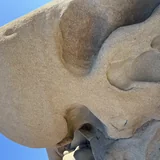
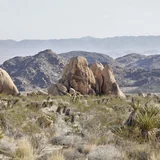
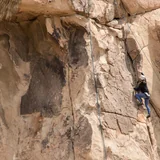
This is where Joshua Tree earns its reputation as a park you can love from the road. The main paved road through the boulder country connects the west and north entrances and threads directly past the sights, so a slow drive with a few pullouts delivers most of the park's greatest hits without a hike. Skull Rock, the boulder weathered into the shape of a skull, sits right beside the road near Jumbo Rocks Campground; its two hollow eye sockets were worn by water pooling and weathering the granite over many thousands of years. Cap Rock is a named boulder with its own short loop. The Hall of Horrors is a roadside cluster of monzogranite formations between the Ryan and Sheep Pass areas, popular with climbers scrambling among the slots — a fine thing to watch from a distance.
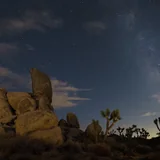
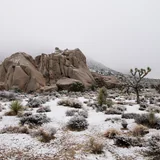
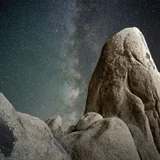
Those boulders have a story you can appreciate from your seat. They are monzogranite, a pale, granitic rock that cooled from molten magma miles underground more than 100 million years ago. Groundwater seeping along cracks slowly rounded the rectangular blocks into spheres, and when the climate dried out, flash floods washed away the softened material and left the rounded boulders stacked one atop another. That is why the piles look the way they do, like giant rounded blocks tumbled together. The same slow process shaped the Wonderland of Rocks, a maze of monzonite domes and formations that rise up to about 300 feet tall in the park's interior; you cannot drive into its heart, though its edges show from the road.
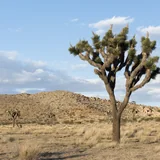
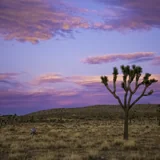
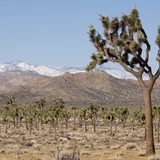
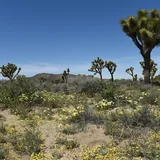
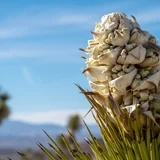
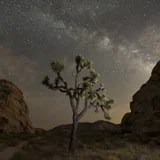
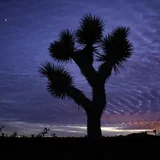
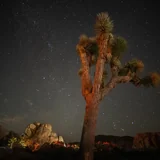
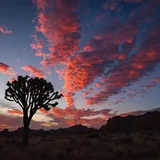
The Joshua tree rewards a closer look even through a windshield. Despite the name, it is a yucca rather than a true tree, Yucca brevifolia, with no growth rings and no true wood. It grows slowly — somewhere between half an inch and a few inches a year — and an average tree lives around 150 years, with some estimated to pass 300; the tallest can top 40 feet. Each one depends on a single partner, the yucca moth, which packs pollen onto the flowers and lays its eggs inside them, so the moth feeds its young and the tree makes its seeds. Neither can reproduce without the other. Knowing that, the crooked, shaggy shapes along the road are easy to appreciate as slow, living things going about a long life.
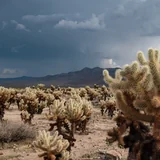
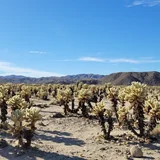
The Joshua trees themselves are thickest in the higher, cooler western and northern half of the park, so the drive in from the west entrance runs through some of the best stands. Head south on the road toward the park's lower country and the scenery shifts: the Cholla Cactus Garden, a dense stand of teddybear cholla, sits in the Pinto Basin about 12 miles south of the north entrance, and beyond it the ocotillo and creosote of the hotter Colorado Desert take over. Keep your eyes on the roadside and the sky for wildlife, too. A black-tailed jackrabbit with its oversized ears or a red-tailed hawk riding the thermals are common sights you can enjoy without ever leaving the car, and with some luck you might also catch a greater roadrunner, which the park lists as uncommon, darting across the pavement. You might also notice a cactus wren, the largest wren in North America, which builds its bulky nests down in the spiny cholla, or a covey of Gambel's quail crossing the road in single file.
Planning an Easy Day
Here is how the pieces fit into one unhurried day. Start at the house and fuel up in Yucca Valley or Joshua Tree, since there is no gas inside the park. From Stargaze Escape it is about 25 minutes to the west entrance at Joshua Tree Village, the busiest and most convenient gate on this side. Drive the paved main road east through the boulder country, stopping at the roadside formations and the thickest Joshua tree stands as the mood takes you.
Turn off for Keys View and spend time at the overlook, using the paved lower path and its tactile maps. When you are ready for a walk, continue toward the north entrance and on to park headquarters in Twentynine Palms, where the paved Oasis of Mara loop and the accessible restrooms with grab bars make a natural midday base. That single loop, taken slowly with the benches for rests, is a satisfying way to be among the palms. Then you can retrace the drive back toward the west side and home.
If you are coming up from the Palm Springs or Coachella Valley side instead, there is a second easy plan. Enter through the South Entrance at Cottonwood, off Interstate 10, where the Cottonwood Visitor Center has water and flush toilets. From there the Cholla Cactus Garden and the Bajada Nature Trail — the boardwalk path through the Colorado Desert plants — are both close to the road in the park's lower country. It is a gentler, warmer landscape than the boulder highlands, and it makes a good half-day on its own.
Because the house is only about 25 minutes from the west entrance, you do not have to see everything in one push. Many guests split the park across two short mornings — the boulder country and Keys View one day, the Oasis of Mara another — and come back to rest, swim, and cool off in between. For anyone managing fatigue or heat, two easy half-days beat one long one.
A few practical notes make the day go smoothly. Bring more water than you expect to drink, pack snacks and layers, and download an offline map before you lose the signal. Entrances occasionally close briefly for construction or weather, so glance at the park's current alerts the morning you go. And because the park never closes, there is no rush to beat a gate — you can let the heat, not a clock, decide your turnaround. When you are back, the stock-tank pool and hot tub at the house are waiting, and our getting here page has the exact directions and drive times for the routes in from the airports and the freeway.
Accessibility at the House
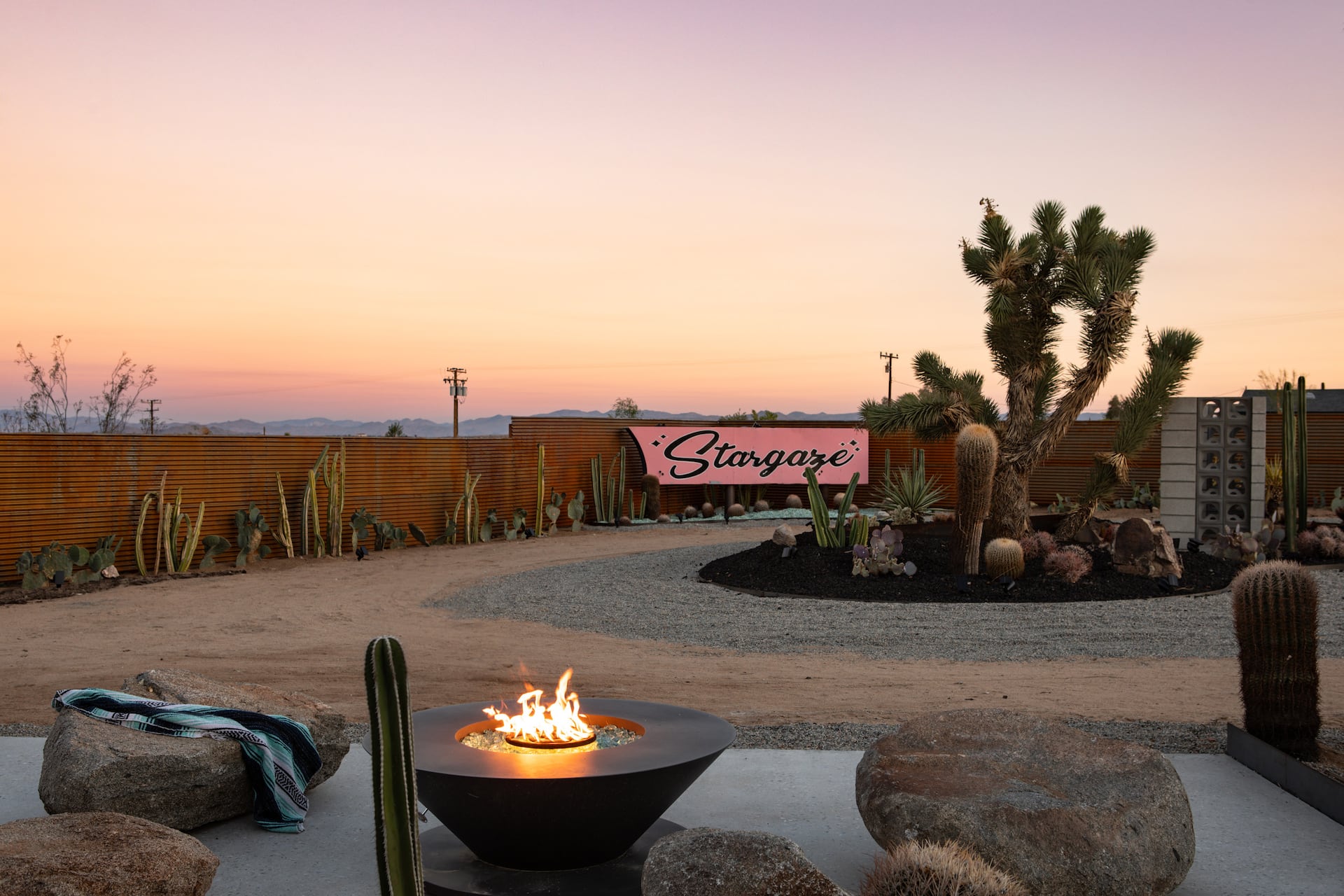
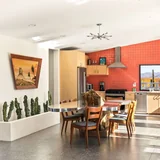
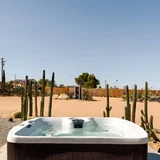
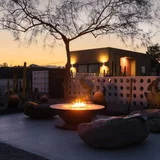
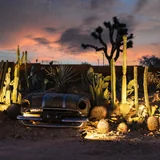
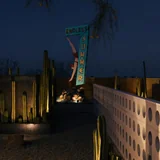
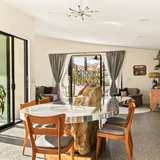
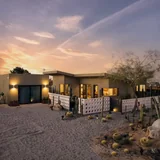
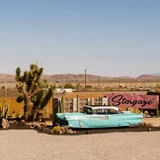
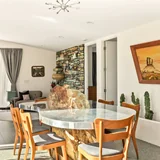
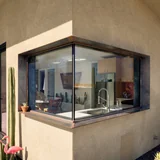
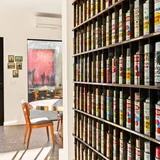
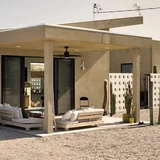
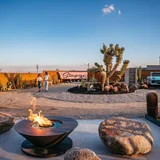
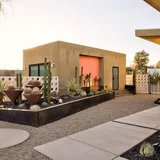
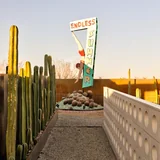
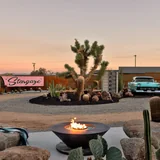
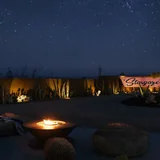
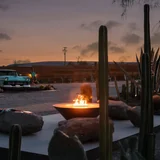
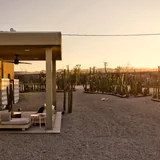
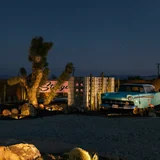
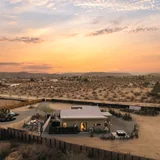
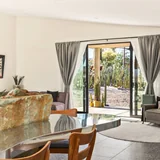
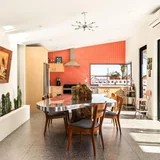
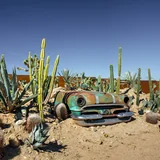
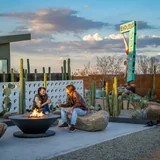
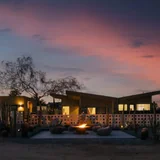
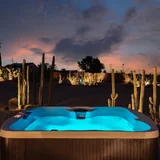
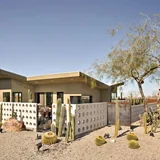
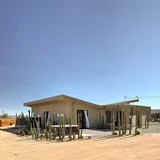
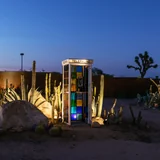
Stargaze Escape is an Airbnb Luxe whole-house rental in Yucca Valley, and we would rather tell you plainly what it is than dress it up. It sleeps four in two king bedrooms and has one bathroom, all to yourselves, on a fully fenced desert lot planted with cacti, agave, and Joshua trees. The outdoor ground is gravel, which is worth knowing if wheels or a firm surface matter to your group. Out back there is a stock-tank pool under a vintage painted metal sign, a hot tub that stays open all year, an indoor freestanding soaking tub by a window onto a private courtyard, and a gas fire pit ringed by natural boulders. A restored 1950s car has been turned into an open-air bed, parked on the gravel, if someone in your party wants to sleep out under the stars. There is a full kitchen, an outdoor grill, air conditioning and heating, wifi, and free parking on site. Dogs are welcome; cats are not, because of a household allergy.
Because every guest's needs are different, the honest thing is to ask us before you book. We can walk you through the specific layout — doorways, thresholds, the path from the parking to the door, the surfaces around the pool and the courtyard — so you can decide whether the house works for you, rather than guess from photos. We would much rather have that conversation up front than have you arrive to a surprise. Our accessibility page collects what we know about the property, and you can send any question straight through the booking.
If you are weighing whether an accessible Joshua Tree trip is right for your group, the shape of it is clear: a paved oasis loop, a drive-up overlook, miles of roadside boulders and trees, and a fenced, private house 25 minutes away to rest and swim between outings. Start by reading the accessibility details and messaging us with your questions, then check the dates and book when you are ready.