









Food & Drink
Eating and Drinking in the High Desert
You will not find a restaurant row or a food hall out here. The eating in the high desert is strung thin along one highway, in low buildings that give little away from the road, and it runs from a home-cooking diner that has been open since 1977 to a New California kitchen that serves lunch four days a week. This is a plain rundown of where to eat and drink around Yucca Valley and Joshua Tree, town by town, plus the case for cooking a night or two back at the house. One thing before you go anywhere: hours out here change with the season and the week, so check a place's own website or Instagram, or call, before you drive to it.
The Food Along Highway 62
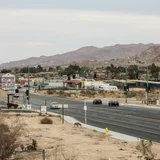
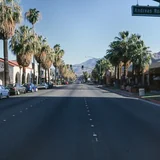
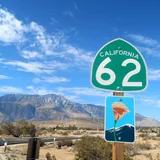
Almost everything worth eating sits on or just off California State Route 62, the Twentynine Palms Highway. It is the main east-west road through the Morongo Basin, running from the Interstate 10 junction near Palm Springs up through Morongo Valley, Yucca Valley, the town of Joshua Tree, and Twentynine Palms along the park's north boundary. Yucca Valley and Joshua Tree town are about seven miles apart, roughly a twelve-minute drive, so the whole eating map is smaller than it first looks. From the house the west park entrance is about twenty-five minutes, and most of these kitchens are closer than that.
It helps to know what is not out there. Inside Joshua Tree National Park there are no restaurants, no grocery stores, and no gas stations, and there is no water in the park interior. The park service asks visitors to bring all their own water, a common guideline being at least a gallon per person per day, and to fuel up in the gateway towns first. That means the towns do all of the feeding, and a park day works best when you have eaten and packed before you reach the gate. You can read more about the surrounding towns and how they string together on the area overview.
Which town you eat in often follows which gate you use. The West Entrance, the busiest, sits at Joshua Tree village about five miles south of the Highway 62 and Park Boulevard junction, so the town of Joshua Tree is the natural breakfast-and-fuel stop for a west-side day, and it is the entrance the house is closest to. The North Entrance is in Twentynine Palms, three miles south of the Utah Trail junction, which puts that town's kitchens on your way in and out. The South Entrance near Cottonwood Spring comes off Interstate 10 on the Palm Springs side, farther from every town, so if you enter that way, arrive already fed and watered. With no gas inside the park either, top up in Joshua Tree, Yucca Valley, or Twentynine Palms before the gate.
Yucca Valley sits at roughly 3,300 feet, high enough that the heat is a notch gentler than the low desert around Palm Springs, so patio meals are comfortable more of the year here than you might expect. If you want a bigger-city dinner one night, Palm Springs is about fifty minutes from the house, down the hill into the low desert, though everything in this post is closer and easier. The pattern most guests fall into is coffee and breakfast in one of the towns, a packed lunch in the park, and then either a dinner out or a cook-in back at the house. The sections below walk through each of those, starting with the tables worth planning around.
La Copine and the Destination Restaurants
The one kitchen people plan a lunch around is La Copine, out in Flamingo Heights on Old Woman Springs Road, the Highway 247 stretch north toward Pioneertown. Its mailing city is Yucca Valley, but the restaurant sits on its own in that quiet corridor, which is part of the appeal. It cooks a New American, New California menu that rotates with the season, it serves lunch rather than dinner, and it is open Thursday to Sunday from 11am to 4pm, closed Monday to Wednesday. Those are short hours, and hours change, so check before you go.
Because the menu rotates with the season, no two visits read quite the same, which is part of why regulars keep coming back through the year. It is a set of dishes built around what is good that week, served over a short daytime window, so it rewards a little planning. Reservations are by text, up to four weeks out, and walk-ups are welcome.
Because La Copine keeps short hours and does not open every day, this is the meal to sort out first when you are planning the week. Look at its current schedule before you fix your other days around it, and aim for a lunch early in your stay so you have a fallback day if the one you wanted is closed or booked. If you want a fuller sense of the place and how to time a visit, we wrote a whole post on eating at La Copine.
It is not the only kitchen out here that rewards a plan. Over in Twentynine Palms, at the far end of the highway, there is a small Caribbean and New American restaurant that also draws people out of their way; that one is covered further down with the rest of the north end. The point for now is that the high desert has two or three tables worth arranging your days around, and both La Copine and its Twentynine Palms counterpart keep the kind of limited hours that reward a little planning.
Pappy and Harriet's in Pioneertown
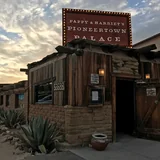
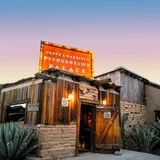
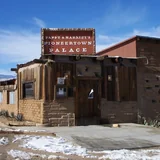
Up the hill northwest of Yucca Valley, on Pioneertown Road, is the best-known name in high-desert food and music: Pappy & Harriet's Pioneertown Palace. Pappy & Harriet's is a western barbecue and Tex-Mex roadhouse with a bar and a patio, and it books national touring acts and local players on its live-music stage. That combination is why the parking lot fills on show nights and why the wait for a table can run long.
Pioneertown itself sets the scene. It was built beginning in 1946 as a live-in Old West movie set, with functioning buildings that doubled as film facades and as real homes and businesses, and more than fifty films and TV shows were shot along its Mane Street. That history is worth an afternoon on its own, and we cover it in the Pioneertown guide. Right on Mane Street you will also find the Red Dog Saloon, a restored Old West saloon that first opened in 1946 and reopened in 2020, now pouring a full bar with a large spirits list and serving Tex-Mex, so you can make an early stop there before or after Pappy's.
If you are coming for a concert, treat the meal and the show as two separate bookings and check both ahead: the restaurant takes reservations that go quickly, and shows are ticketed and sell out. Our post on a night at Pappy and Harriet's walks through how to line up dinner, a drink on the patio, and a set without rushing any of it. From the house it is a short enough drive that Pioneertown makes an easy evening, but it is still a drive, so sort out who is not drinking before you leave.
Even on a night with no headliner, the patio is a fine place to sit with a plate of barbecue as the desert cools off, and the walk down Mane Street to see the 1946 film-set buildings makes the trip more than a meal. If you would rather have your barbecue at home, this is also the town to pick up something to grill later, but most people come for the room itself, which has been the anchor of the Pioneertown scene for a long time.
Cafes and All-Day Kitchens
For breakfast and lunch the towns run on a handful of cafes and diners, most of them long-standing local rooms rather than anything polished. In downtown Joshua Tree, Crossroads Cafe is the classic near the west entrance: an American diner-cafe doing scratch breakfast and lunch, with beer and wine, and it has been a village favorite for years. It sits right on the highway, so it is an easy first stop on a morning you are headed into the park.
A few doors along that same stretch is JT Country Kitchen, a small home-cooking spot for breakfast and brunch that is billed as the village's longest continuously operating restaurant, cooking since 1977. It does not take reservations, so on a weekend you go early or you wait. Over in Yucca Valley, Frontier Cafe is the all-day room I point people to first: a coffeehouse and cafe with pastries, sandwiches, and vegan and gluten-free options, brewing beans from a local roaster, with a dog-friendly patio, which matters if you have brought the dog along.
A couple more worth knowing. In Joshua Tree, Sam's Indian Food & Pizza is a casual, long-established spot doing exactly what the name says, Indian dishes and pizza, with delivery through Uber Eats if you would rather eat back at the house. In Yucca Valley, La Casita Nueva is a sit-down Mexican restaurant with margaritas and a Sunday brunch that is easy with kids, though it is worth confirming its current days before you count on it. None of these are fussy places; they are where locals actually eat, and that is the point of them.
Two practical habits make the cafes work in your favor. On weekend mornings the diners fill and there is no reservation to fall back on, so if you want breakfast before a park day, go early or expect a wait. And most of these kitchens do a sandwich or a to-go order, which is the simplest way to solve lunch: order something to carry, because there is nowhere to buy food once you pass the entrance. Frontier's vegan and gluten-free options are handy if your group has a mix of diets, and its dog-friendly patio means nobody has to be left behind at the house for a morning coffee.
Coffee in the High Desert
Coffee is taken seriously here, mostly because of one roaster. Joshua Tree Coffee Company is an organic, small-batch roaster in downtown Joshua Tree with a cafe counter, roasting on a Loring roaster, and it is the specialty name the area is known for. You can drink it at the counter, and you can also carry a bag of whole beans back to the house, which is what I would do for slow mornings by the pool.
You will taste those same beans around town without going to the source. Frontier Cafe in Yucca Valley brews Joshua Tree Coffee beans, so a morning stop there gets you the local roast with a pastry and a dog-friendly table. Between the roaster's own counter and the cafes pouring its coffee, you can put together a good cup most mornings without much hunting.
The house has a full kitchen, so the easy move is to buy a bag of beans on your first town run and brew your own the rest of the week. That is the version I like best: a cup made in the kitchen and carried out to the stock-tank pool while the desert is still cool, before the day heats up and the light gets flat. It saves the drive on the mornings you would rather move slowly, and it means you are not depending on a cafe's opening hours to get going.
If coffee is a real part of how you travel, it is worth mapping your mornings around it, and we go deeper into the roasters and cafes in the guide to coffee in the high desert. A practical note for park days: there is no coffee, and no water, inside the park, so fill a thermos in town before you drive to the gate. A warm cup at a trailhead in the cool early hours is one of the small, real pleasures of a desert morning, and you have to carry it in yourself.
Bars and a Drink After Dark
The high desert keeps a handful of good bars, most of them attached to a kitchen and a stage. In the town of Joshua Tree, the Joshua Tree Saloon is a western-themed restaurant and dive bar-grill doing burgers and pulled pork with a full bar, karaoke, and live music on weekends. In Yucca Valley, the Tiny Pony Tavern is often lumped in with the Pioneertown crowd but sits right on the highway in town; it does scratch food and a weekend brunch, runs karaoke, DJ, and drag nights, and has a dog-friendly backyard. Up in Pioneertown, the Red Dog Saloon and the bar at Pappy's cover the Old West end of a night out.
For spirits made close to home, the Joshua Tree Distilling Company in Yucca Valley is a craft distillery with a tasting room, a different animal from the local beer scene, though it is worth checking its current tasting-room hours before you go. On the beer side, there is a local brewery in the area, but the taproom footprint has been shifting between the towns, so confirm which one is actually open before you set out for it. Out in Landers, the Giant Rock Meeting Room started as a coffee house and now runs as a live-music pizza bar on limited, appointment-style evening hours, so it takes a little more planning than a walk-in.
Two practical notes. Most of these are a real drive apart from one another and from the house, so decide who is not drinking before you leave, the same as you would for a Pappy's night. And the desert has more going on after dark than bars; the same towns run a steady calendar of live music, which we track in the guide to live music on desert nights. Back at the house, remember quiet hours start at 10pm, so a nightcap is best kept to the hot tub or the fire pit rather than a late crowd.
Twentynine Palms and the North End
Twentynine Palms is the town at the park's north entrance, east along Highway 62 past Joshua Tree village, and it is worth the drive for a few specific places. Kitchen in the Desert is the destination table mentioned earlier: a small Caribbean and New American restaurant from chef Everton Gordon, known for its jerk chicken, serving brunch and dinner. Like La Copine it is a compact, sought-after room that keeps limited hours, so book ahead and check the days it is open.
For bread and baked goods, Campbell Hill Bakery is a small husband-and-wife shop in downtown Twentynine Palms turning out bread, bagels, pastries, sandwiches, and a thick, Detroit-style pan pizza. It keeps very limited days and hours, so it is a plan-around rather than a drop-in; check before you make the trip. If you are staying near the north side or entering the park that way, it is a good provisioning stop for a loaf to take back.
The other north-end anchor is the restaurant at the 29 Palms Inn, at the Oasis of Mara. The inn dates to 1928, and its kitchen does New American cooking with seafood and steaks, poolside dining, a full bar, and frequent live music, with some produce coming from its own Faultline Farm. It is the kind of sit-down dinner that pairs naturally with a morning walk on the paved Oasis of Mara loop right there at park headquarters, which also has a water-bottle filling station if you need to top up before a park day. Part of the loop has been closed after flood damage, so check the park's alerts first.
There is also a long-running rib house in the area, The Rib Co, family-run since 1997 and doing barbecue and ribs. Its location and open status have moved between Yucca Valley and Twentynine Palms in recent years, so treat it as a maybe and confirm it is open, and where, before you make a trip for it. All told, Twentynine Palms rewards the extra miles more than people expect, especially on a day you are already exploring the park's north and east, and it is the logical dinner town if you have spent the afternoon out at the Cholla Cactus Garden or the Pinto Basin.
Markets and Provisions
If you are cooking at all, and there are good reasons to, the grocery anchor is Stater Bros. There are two stores in Yucca Valley on Twentynine Palms Highway and another in Twentynine Palms, and one of them will be the closest full supermarket to wherever you are. Stock up there on the way in, because the towns are small and you do not want to be hunting for a missing ingredient after a long park day.
For something better than a supermarket run, time your trip around the Joshua Tree Certified Farmers' Market. It is held on Saturday mornings in downtown Joshua Tree, roughly eight to one, with local produce, prepared foods, baked goods, and crafts, though it is a seasonal, weather-dependent event, so confirm it is running the weekend you are there. It is the easiest way to buy a good desert breakfast and a bag of vegetables to grill later, and we cover the region's markets in the guide to high-desert farmers markets.
Round out the provisions with the specialists. Whole beans from Joshua Tree Coffee Company keep your mornings sorted, a loaf from Campbell Hill Bakery covers breakfast and sandwiches, and the farmers market or Stater Bros handles the rest. Because there is nothing to buy inside the park, do your shopping on a town day, not on your way to a trailhead. A cooler packed the night before turns a park morning from a scramble into a clean early start.
Water deserves its own line on the list. The park interior has none, so buy or fill enough before you go, working from that gallon-per-person-per-day guideline and adding more in warm weather. If you need to top up on the way, the visitor centers at the edges have filling stations, including the Joshua Tree National Park Visitor Center in Twentynine Palms, Cottonwood on the south end, and Black Rock in Yucca Valley, but do not count on finding water once you are past the entrance. It is cheaper and simpler to fill jugs at the house and load them into the cooler with the food.
Cooking In at the House
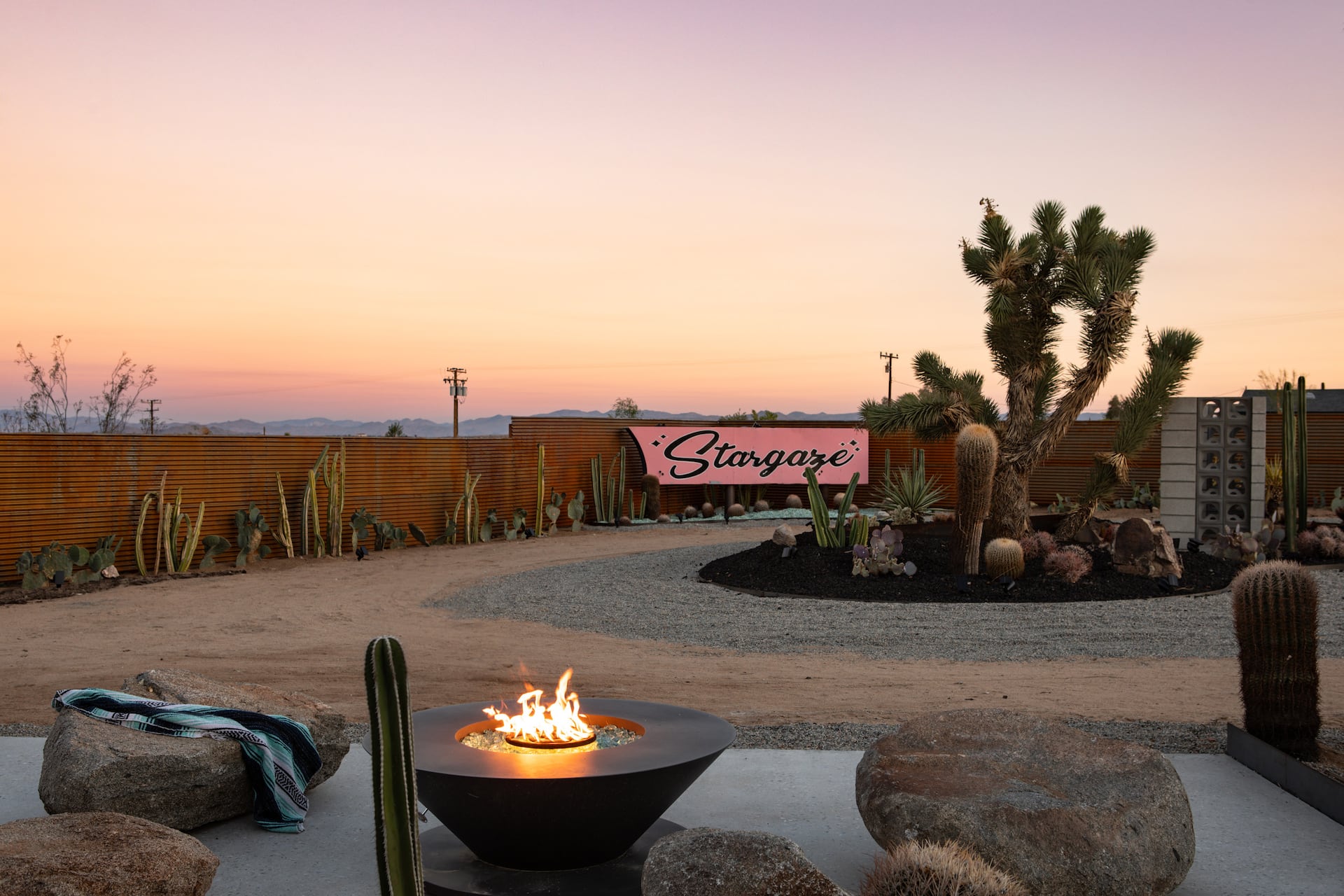
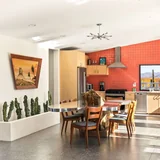
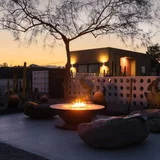
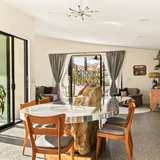
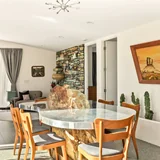
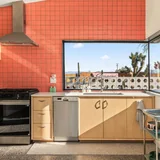
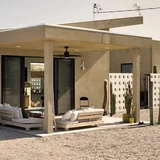
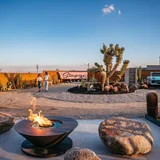
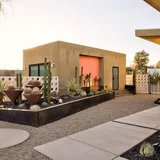
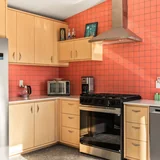
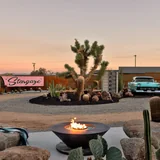
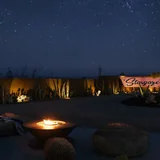
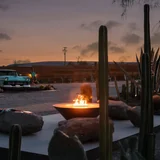
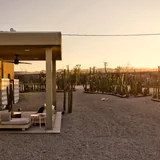
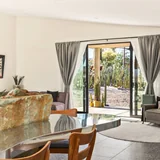
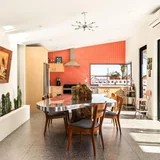
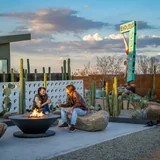
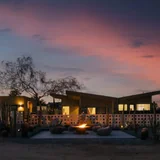
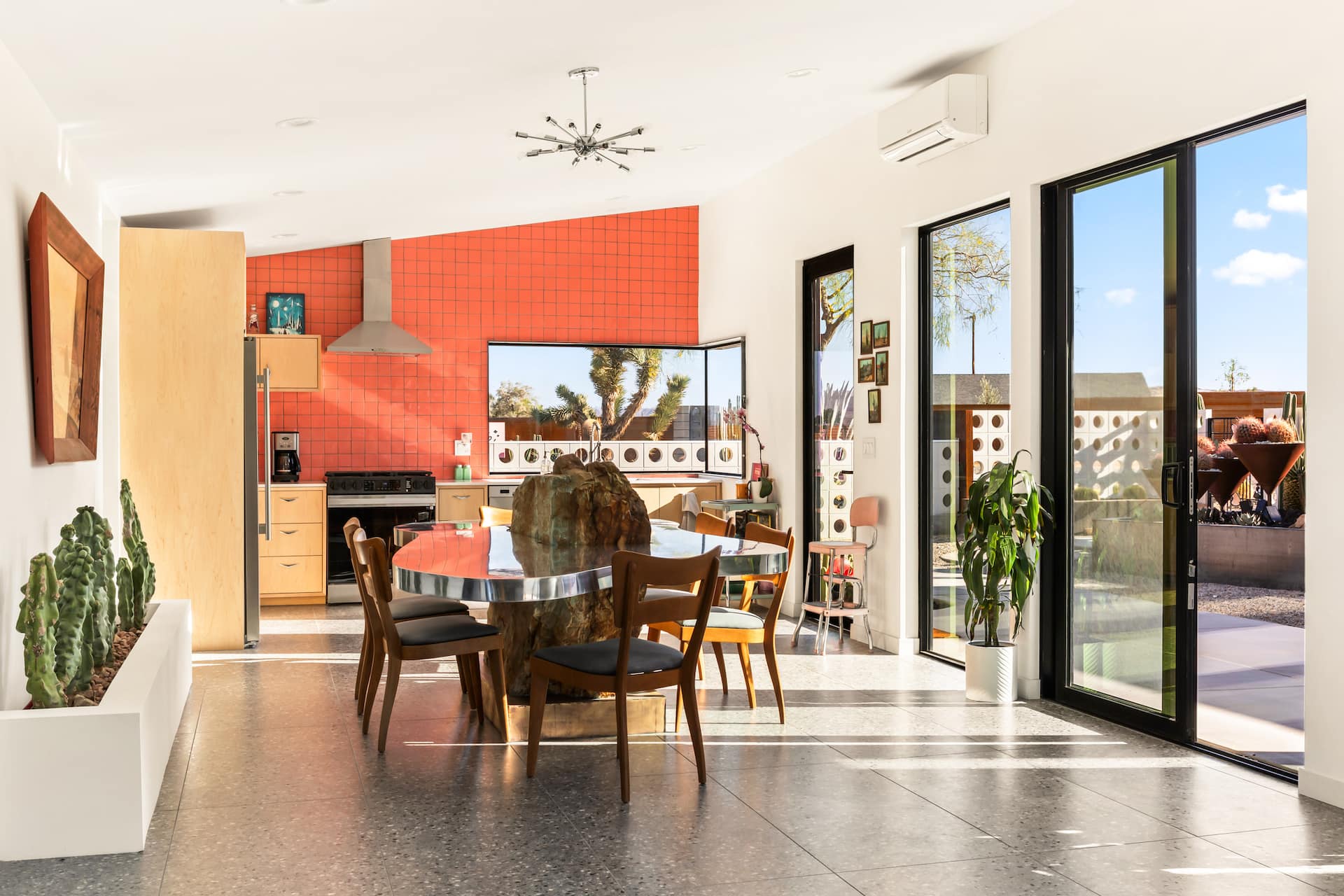
Not every meal needs a drive. The house has a full kitchen and an outdoor BBQ grill, and on a warm evening the outdoor cooking is the better option. You can grill whatever you carried home from Stater Bros or the Saturday market and eat at the dining table built around a natural boulder, with the stock-tank pool and the gas fire pit a few steps away. The fire pit burns gas, so there are no logs to haul or ash to clean; you turn it on, and it rings a circle of natural boulders where people end up sitting after dinner.
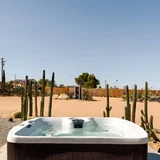
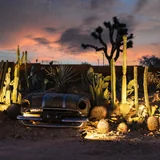
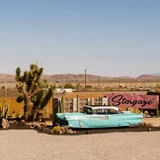
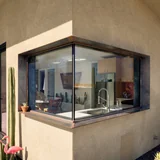
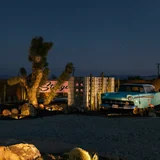
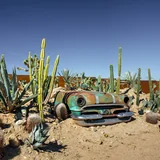
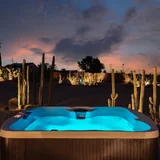
A cook-in night pairs well with the rest of the yard. Dinner outside, then a soak in the hot tub, which is open all year, or a swim in the stock-tank pool while it is warm, and later some time under the stars from the car bed. The car bed is a restored 1950s car turned into an open-air bed, parked on the gravel with a custom stargazing roof that can be pulled back, and it is where a lot of evenings end once the dishes are done. The pool has a star-perforated steel screen around it for privacy, and there is a freestanding soaking tub indoors by a wide window onto a courtyard if you would rather have your after-dinner soak inside.
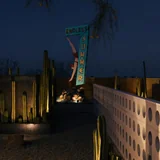
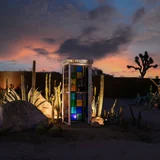
One house rule matters at the table: no glass near the pool or the hot tub, so decant into something unbreakable if you are carrying a drink out that way. Quiet hours start at 10pm and parties are not allowed, so the fire pit and the hot tub are the right speed for a late evening rather than a crowd. If you have brought the dog, the yard is fully fenced and dogs are welcome, though cats are not, because of a household allergy. There is also a stained-glass telephone booth on the lot, and the dark sky overhead is reason enough to eat late and stay outside.
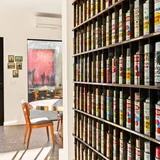
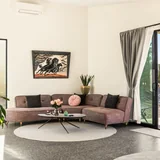
We keep a longer piece on making the most of the kitchen and grill in cooking in the desert kitchen, and you can see the layout of the indoor space on the living and kitchen page. The honest case for cooking in is this: after a full day in the park, a grill, a table by the boulder, and a quiet evening at the house is often more of what you came for than another drive to town. Alternate a night out with a night in and you get the best of both.
Planning Meals Around Your Days
Put together, a good eating week out here follows a simple rhythm. Start mornings with coffee and breakfast in town, at Frontier Cafe, Crossroads, or JT Country Kitchen, and fill a thermos and water bottles while you are there. Pack a lunch, because the park has nothing to buy and no water inside it. Then choose each evening between a dinner out and a cook-in, and try not to stack two long drives back to back.
Fix the hard-to-get tables first. La Copine, Pappy & Harriet's, and Kitchen in the Desert all keep limited hours and fill up, so book those early and let your easier meals, the cafes, the grill nights, fall in around them. If your stay includes a Saturday, plan a market morning in Joshua Tree, and if it includes a show, keep that evening free of a far-flung dinner. Above all, check current hours and days before every trip out; short, seasonal, and shifting schedules are the one constant in high-desert dining.
Here is how a three-night stay might fall into place. On the arrival day, stop at Stater Bros on the way in, fill the cooler and the water jugs, and grill the first dinner at the house so you are not driving again after the road. The next morning, breakfast and beans at Frontier or Crossroads, a packed lunch in the park, and dinner in Pioneertown at Pappy & Harriet's, timed around a show if there is one. On a Saturday, hit the Joshua Tree farmers market early, take a late lunch at La Copine, keep the rest of the afternoon slow by the pool, and hold the evening for the drive out to Kitchen in the Desert in Twentynine Palms. Adjust the order to your reservations, and leave at least one night for the grill and the fire pit.
The kitchen, the grill, the boulder table, and the fire pit make the house an easy base for all of it, a place to come back to and cook, swim, and sit out under a dark sky between meals out. When you are ready to set the dates, you can check availability and book, then build your restaurant reservations around the nights you are here.